Georgia and Armenia together hold seven UNESCO World Heritage Sites, with Georgia contributing four (three cultural, one natural) and Armenia adding three (all cultural). For travelers driving through the Caucasus, most of these sites sit within easy reach of major cities and can be visited on day trips or worked into a broader road trip. Here is every inscribed site, what makes each one worth the stop, and exactly how to reach it.
UNESCO Sites in Georgia
Colchic Rainforests and Wetlands (2021)
Georgia's newest and only natural UNESCO site covers seven protected areas along the Black Sea coast: Kolkheti, Mtirala, Kintrishi, and Kobuleti among them. These are ancient broadleaf Colchic rainforests, wetlands, and mire bogs sheltering over 1,100 plant species (including 44 threatened) and 19 threatened animal species. The density of endemic flora here is exceptional, and the area is one of the most important migratory bird habitats in the Caucasus.
How to visit: Batumi is the ideal base. Mtirala National Park (30km), Kintrishi Nature Reserve (60km), and Kobuleti Nature Reserve (35km) all have marked hiking trails and are reachable on paved roads in any car. Kolkheti National Park near Poti requires a boat excursion on Paliastomi Lake. Combine several of these into a 2-3 day Black Sea coast loop.
Upper Svaneti (1996)
Probably Georgia's most iconic UNESCO site. The medieval defensive stone towers of Svaneti, built by the Svan ethnic group as fortified family dwellings, rise across verdant valleys against the Greater Caucasus backdrop. Over 200 towers cluster in the village of Chazhashi alone, part of the remarkable settlement of Ushguli, one of Europe's highest continuously inhabited villages.
How to visit: Base in Mestia, reached by sealed road from Zugdidi (3 hours) or via the Lentekhi route from Kutaisi (open May-October). Day trips to Ushguli (1.5-2 hours) are straightforward. The full Zugdidi-Mestia-Ushguli-Lentekhi-Kutaisi loop is now drivable in any vehicle, making it one of Georgia's best road trips.
Historical Monuments of Mtskheta (1994)
Georgia's ancient capital, just 20 minutes north of Tbilisi, encompasses three medieval landmarks: Jvari Monastery (perched on a hilltop above the confluence of two rivers), Svetitskhoveli Cathedral (where Georgia's most important monarchs are buried), and Samtavro Convent. Mtskheta is where Christianity was first adopted as Georgia's state religion in the 4th century, and it remains the seat of the Georgian Orthodox Church.
How to visit: Under an hour from Tbilisi by car. Stop on your way north along the Georgian Military Highway toward Gudauri and Kazbegi rather than making a separate trip. Jvari Monastery requires driving up a separate hill road for the panoramic view.
Gelati Monastery (1994)
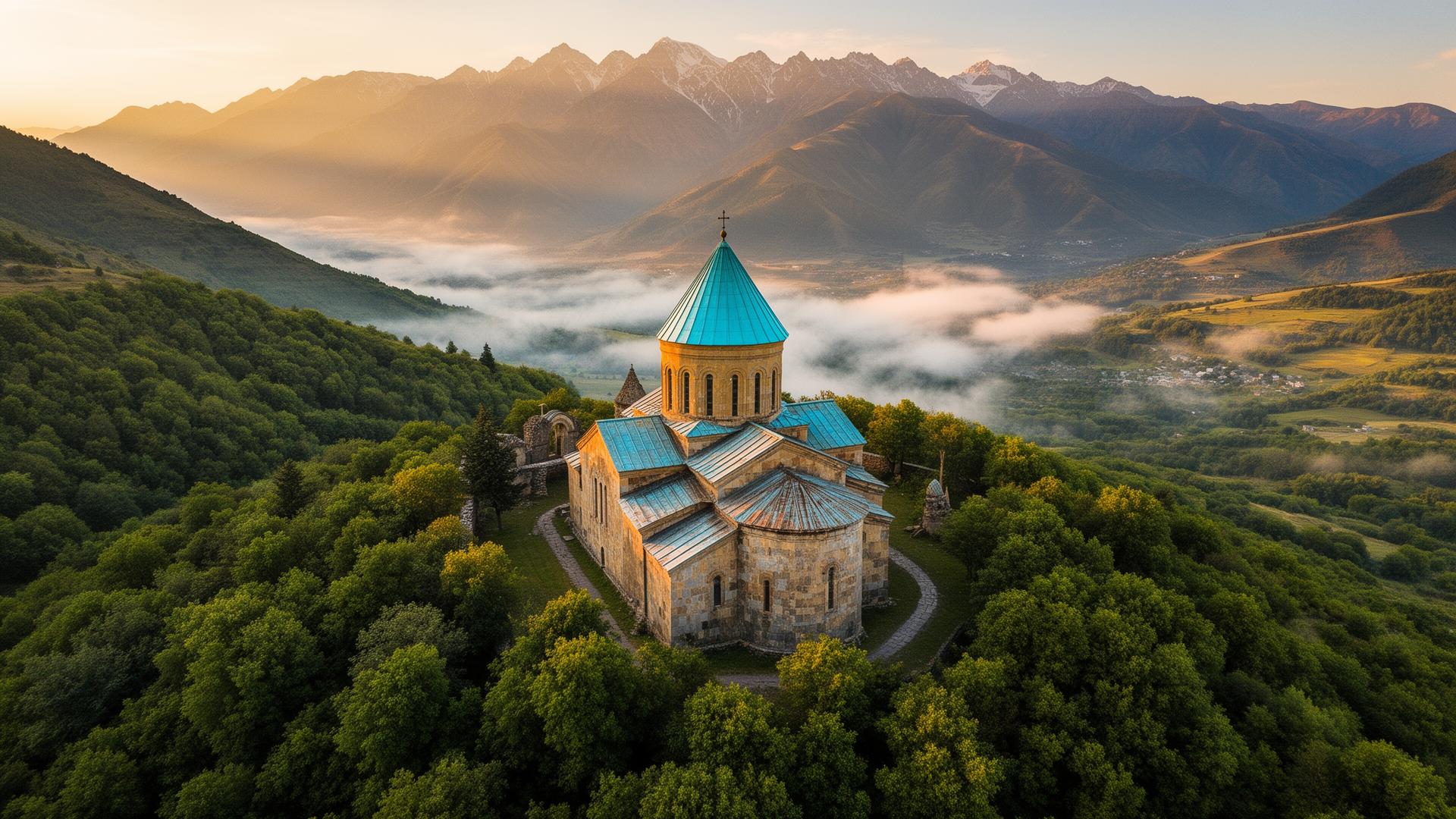
Near Kutaisi, Gelati is one of Georgia's most important landmarks. Founded by King David the Builder after the 1121 Battle of Didgori, it served as a center of learning where Plato's works were first translated into Georgian. The monastery's interior features stunning frescoes, icons, and mosaics beneath a distinctive turquoise roof set against forest canopy. Nearby Motsameta Monastery is connected by a short hiking trail.
How to visit: Just 10km north of Kutaisi, reachable by city bus or any rental car. Combine Gelati and Motsameta in a half-day trip. Add Tskaltubo (20 minutes away) for a full day.
Georgia's Tentative UNESCO Sites
Georgia has 14 properties on the tentative list, several of which are highlights of any road trip:
- Vardzia — the spectacular cave monastery carved into cliff faces in Samtskhe-Javakheti
- Ananuri Fortress — on the Georgian Military Highway, a natural stop driving to Kazbegi
- Uplistsikhe Cave Town — Georgia's oldest cave city, near Gori
- Nikortsminda Cathedral — in Racha, with vivid frescoes and extraordinary stone carvings
- Alaverdi Cathedral and Gremi — two essential stops on the Kakheti wine route
- Tbilisi Historic District — including the sulfur baths of Abanotubani
- Shatili — the fortified tower village in Khevsureti
- Tusheti — the remote mountain region accessible via Abano Pass
- David Gareja — cave monastery on the Azerbaijan border
- Dmanisi — one of the world's most important hominid archaeological sites, in Kvemo Kartli
Georgia's Intangible Cultural Heritage
Four Georgian traditions are recognized by UNESCO:
- Qvevri winemaking (2013) — the 8,000-year-old method of fermenting wine in buried clay vessels, best experienced on a Kakheti wine tour
- Georgian polyphonic singing (2008) — attend any Orthodox church service on Sunday morning in Tbilisi to hear it
- Georgian alphabet (2016) — three unique writing systems visible at monasteries and churches nationwide
- Chidaoba wrestling (2018) — traditional martial art performed at regional festivals
UNESCO Sites in Armenia
Monastery of Geghard and the Upper Azat Valley (2000)
Partially carved from a cliff face, Geghard Monastery dates to the 4th century and the era when Armenia became the first country to adopt Christianity as a state religion. The complex includes chapels hewn from rock with remarkable acoustics, chambers covered in inscriptions and frescoes, and monks' cells dotted along the canyon wall. Like Gelati in Georgia, Geghard once served as a cultural and ecclesiastical center with its own library and manuscript workshop.
How to visit: Under an hour from Yerevan by car. Typically combined with the nearby Garni Temple (a Hellenistic pagan temple, unique in the region) as a half-day trip. One of the easiest UNESCO sites to reach in the entire Caucasus.
Cathedral and Churches of Echmiadzin and Zvartnots (2000)
The Mother See of Holy Echmiadzin, believed to be the oldest cathedral in the world (4th century), anchors this UNESCO listing west of Yerevan. The complex includes the 7th-century Saint Gayane Church and the archaeological ruins of Zvartnots Cathedral, where a snow-capped Mount Ararat framed by elegant stone arches creates one of Armenia's most photographed scenes.
How to visit: Both sites are under 45 minutes from Yerevan. Easy to combine with other day trips from the capital. Drive yourself with a Yerevan rental or hire a driver for the day.
Monasteries of Haghpat and Sanahin (1996)
Armenia's first inscribed sites are two 10th-13th century monastery complexes in the northern Lori province, close to the Georgian border. They represent the pinnacle of Armenian medieval architecture, combining Byzantine design with local flourishes. Scriptoriums, bell towers, and covered corridors are covered in opulent bas-reliefs and khachkar cross stones. Their location above the dramatic Debed Canyon adds to the atmosphere.
How to visit: Located in far-northern Armenia, these monasteries are most conveniently visited when driving between Georgia and Yerevan via the Tbilisi-Yerevan route. The Debed Canyon road passes close to both sites, making them natural stops on a cross-border road trip.
Armenia's Tentative Sites and Intangible Heritage
Armenia has four properties on the tentative list: the archaeological site of Areni-1 cave (where the world's oldest leather shoe was found), Noravank Monastery, the Iron Age fortress of Erebuni in Yerevan, and the medieval monastery of Tatev (reachable by the world's longest aerial tramway). Armenia also holds seven elements of intangible heritage, including lavash flatbread baking and duduk music.
Planning a UNESCO Road Trip
All seven inscribed sites across Georgia and Armenia can be visited on a single 10-14 day road trip through the Caucasus. Here is a logical routing:
- Days 1-3: Tbilisi → Mtskheta (30 min) → day trips to Uplistsikhe and David Gareja
- Days 4-5: Drive to Kutaisi → Gelati Monastery → Colchic forests at Kintrishi or Mtirala
- Days 6-7: Drive to Svaneti → Mestia → Ushguli (Upper Svaneti UNESCO site)
- Days 8-9: Return via Kutaisi → drive south to Batumi → Kolkheti National Park
- Days 10-11: Drive to Yerevan via Haghpat and Sanahin → Echmiadzin and Zvartnots
- Days 12-13: Geghard and Garni → explore Yerevan → fly home or return to Tbilisi
A rental car is the most practical way to connect all these sites. For paved routes (which covers most UNESCO sites), any sedan works. For Svaneti's mountain roads and the Colchic forest reserves, our fleet handles everything. Cross-border rentals between Georgia and Armenia are available through our Tbilisi to Yerevan service.
For more planning, see our 30 destinations guide, driving tips, seasonal guide, and mountain regions comparison.