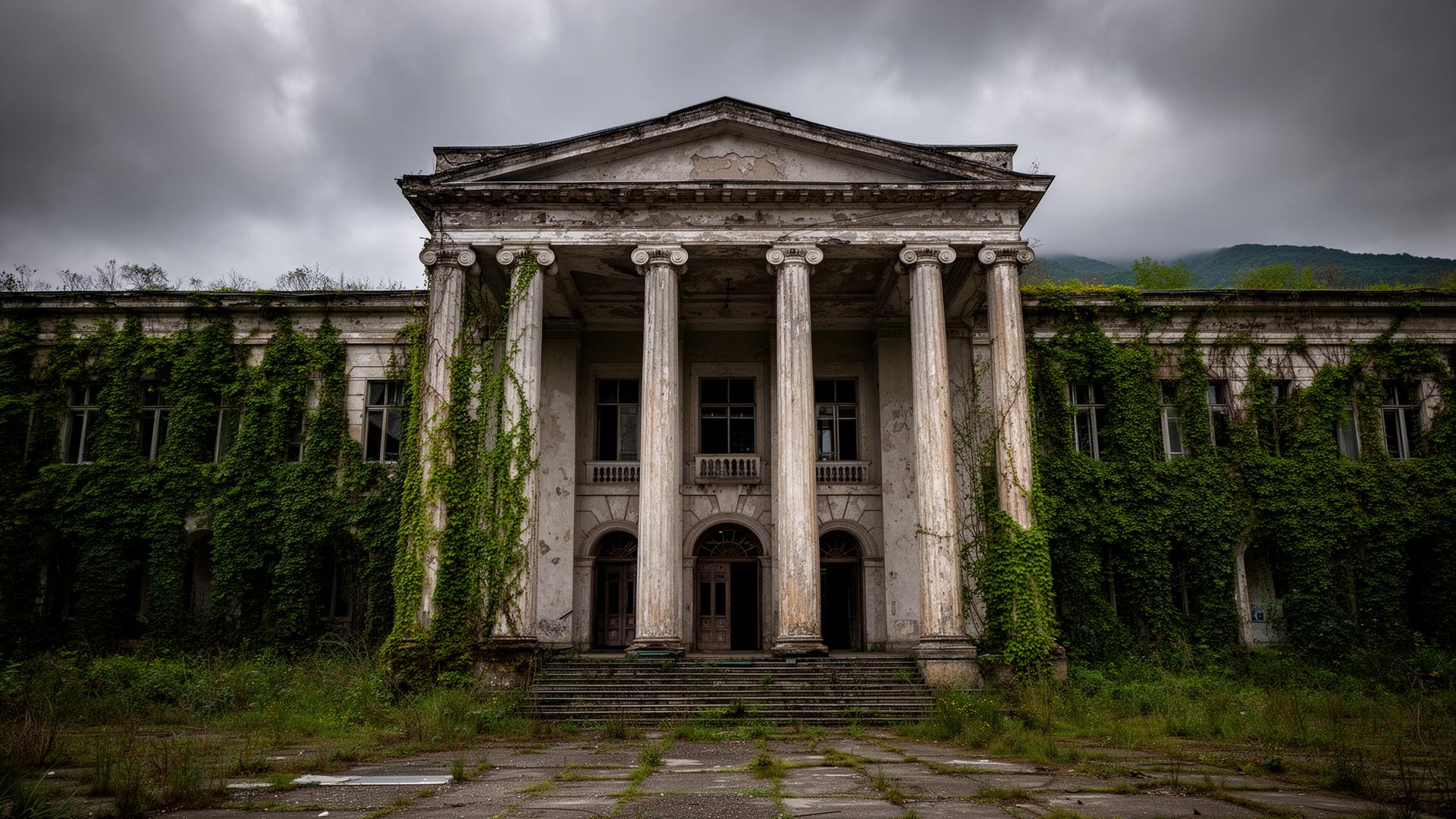
Just 20 minutes from Kutaisi, Tskaltubo is Georgia's most fascinating dark tourism destination. Home to the famous "Waters of Immortality" and once the most sought-after R&R destination in the Soviet Union, the town — with its semi-abandoned sanatoriums and crumbling bathhouses — now attracts a very different kind of visitor.
After the Soviet collapse, the grand neoclassical buildings were left to decay. Internally displaced families from Abkhazia found shelter in the empty halls. Today, investors are circling, construction fences are going up, and Tskaltubo's days as an urbexer's paradise are numbered. If you want to see it, go now.
A Quick History of Tskaltubo
The ground beneath Tskaltubo (literally "a place of water") is coursing with radon-carbonate mineral springs at a natural temperature of 33–35°C. These waters have been documented since the 13th century and were first scientifically analysed in 1913 when Latvian chemist Robert Kuptsis detected radon.
In 1931, the territory was declared a balneotherapy centre. That same year, Joseph Stalin allegedly first visited for treatment. By the 1950s, 22 Soviet neoclassicist sanatoriums and hotels surrounded Central Park, and up to 125,000 people visited annually — there were even direct trains from Moscow.
When the Soviet Union collapsed in 1991, so did the spa industry. Buildings were stripped of tiles, pipes, and furniture. In 1992–93, between 9,000 and 12,000 internally displaced persons fleeing from Abkhazia were given refuge in the old sanatoriums. Decades later, some families still call these crumbling halls home.
Top Sanatoriums to Visit
Sanatorium Iveria
Built in 1962, Iveria is one of the most-photographed buildings in Tskaltubo. The main entrance hall features blue walls and a large round opening in the ceiling revealing the mezzanine floor. Note: Iveria is now surrounded by a metal fence and is sadly inaccessible from inside, though you can still view the impressive facade.
Sanatorium Shakhtiori (Miners' Sanatorium)
Completed in 1952, this is one of the largest and most impressive buildings in Tskaltubo. The front facade is extremely grand — a huge fountain, towering palms, symmetrical sweeping staircases, and infinite columns along every balcony. Inside, the concert hall with its red curtain and painted ceilings is the real highlight. Currently privately owned and fenced.
Sanatorium Metalurgist
The best-preserved sanatorium and a must-visit. The original moulding, wooden banisters, a humongous chandelier, exquisite plasterwork, "his and hers" blue and pink elevators, and incredible wrought-iron stairs are all still intact. A caretaker charges 5 GEL entry. On the western side, a beautiful greenhouse-like atrium has most of its glass windows still intact with a single tree sprouting from the concrete floor.
Sanatorium Gelati
Named after the UNESCO monastery near Kutaisi and completed in 1964. The highlight here is around the back: an incredible Soviet-era mosaic playground with rings, curved walls and angled blocks — the only period children's playground in Tskaltubo, as Gelati was the only facility dedicated to mothers and children.
Sanatorium Medea
A personal favourite. Built in 1955 and named after the mythological princess from Colchis (the ancient kingdom that once occupied western Georgia), Medea is one of the more architecturally striking buildings. The spiral staircase, arched windows, and overgrown courtyards make it incredibly photogenic.
Sanatorium Rkinigzeli (Railway Workers)
Built for railway staff, this sanatorium sits on the western edge of the park. It is one of the more accessible buildings — you can walk freely through the ground floor corridors and see remnants of the original tiled floors and decorative mouldings.
The Bathhouses
Nine bathhouses once operated inside Central Park. Today, springs 2 and 6 are still functioning and offer treatments. The other bathhouses — including the ornate Bathhouse No. 5 with its distinctive circular design — stand empty. You can visit the modern pavilion in Central Park to feel the warm mineral waters with your hand.
Planning Your Visit
Best Time to Visit
Avoid July and August — Tskaltubo is blisteringly hot and everything is outdoors. Autumn (September–November) offers pleasant temperatures and spectacular fall foliage. Winter is also good: bare branches reveal architectural details otherwise hidden by leaves. Read our seasonal guide for more.
How Much Time Do You Need?
Most visitors come as a day trip from Kutaisi, which gives you enough time to explore four to six buildings in detail. If you want to see everything, plan for at least two full days.
What to Bring
- Enclosed walking shoes (debris and broken glass everywhere)
- Hat and sun protection
- Extra camera batteries
- Cash (5 GEL entry for Metalurgist; some places have no card machines)
- Water and snacks (though there are convenience stores in town)
Getting to Tskaltubo
From Kutaisi
Tskaltubo is just 15 km (20–25 minutes) north-west of Kutaisi. A Bolt taxi costs 15–20 GEL. Marshrutka #30 departs from the Red Bridge every 20 minutes (2 GEL). Marshrutka #34 leaves from Central Bus Station hourly.
From Tbilisi
At 240 km (4+ hours), Tskaltubo is not feasible as a day trip by public transport from Tbilisi. The best option is to rent a car in Kutaisi or pick up from Kutaisi Airport and combine Tskaltubo with other attractions in the Imereti region.
Getting Around
Most people explore on foot — the area is compact but deceptively large. If you have a rental car, street parking is easy to find throughout the town. A suggested route starts at the top of the park (Iveria and Shakhtiori) and works anticlockwise past Tbilisi, Geology, Gelati, Metalurgist, then down the western side to Medea.
Responsible Travel Tips
- Some sanatoriums still house families — avoid clearly inhabited areas
- Ask permission before entering: say "Shadesleba shemovide?" and thank people with "Didi madloba"
- Do not photograph residents or their apartments without permission
- Do not trespass on fenced-off private property
- Support the local economy: eat at local restaurants, use local taxi drivers
Is Tskaltubo Safe?
Many buildings are in severe disrepair. Watch for holes in floors, caved-in concrete, and broken glass. Wear enclosed shoes. There are friendly street dogs everywhere — just be aware of territorial ones guarding livestock. In terms of personal safety, Georgia is generally very safe, but solo travellers may want to buddy up as some sanatoriums are down remote paths.
Combine Tskaltubo with a Road Trip
Tskaltubo is best visited as part of a wider Imereti road trip. Combine it with Kutaisi (Gelati Monastery, Bagrati Cathedral), the Prometheus Cave, Martvili Canyon, and the Sataplia Nature Reserve. For a longer trip, continue west to Batumi or south toward the mountains via 4x4.
We offer free delivery to Kutaisi Airport and anywhere in Kutaisi city. No deposit, unlimited mileage, and prices from €40/day. For more off-the-beaten-path ideas, read our hidden gems guide or our Kvemo Kartli guide.