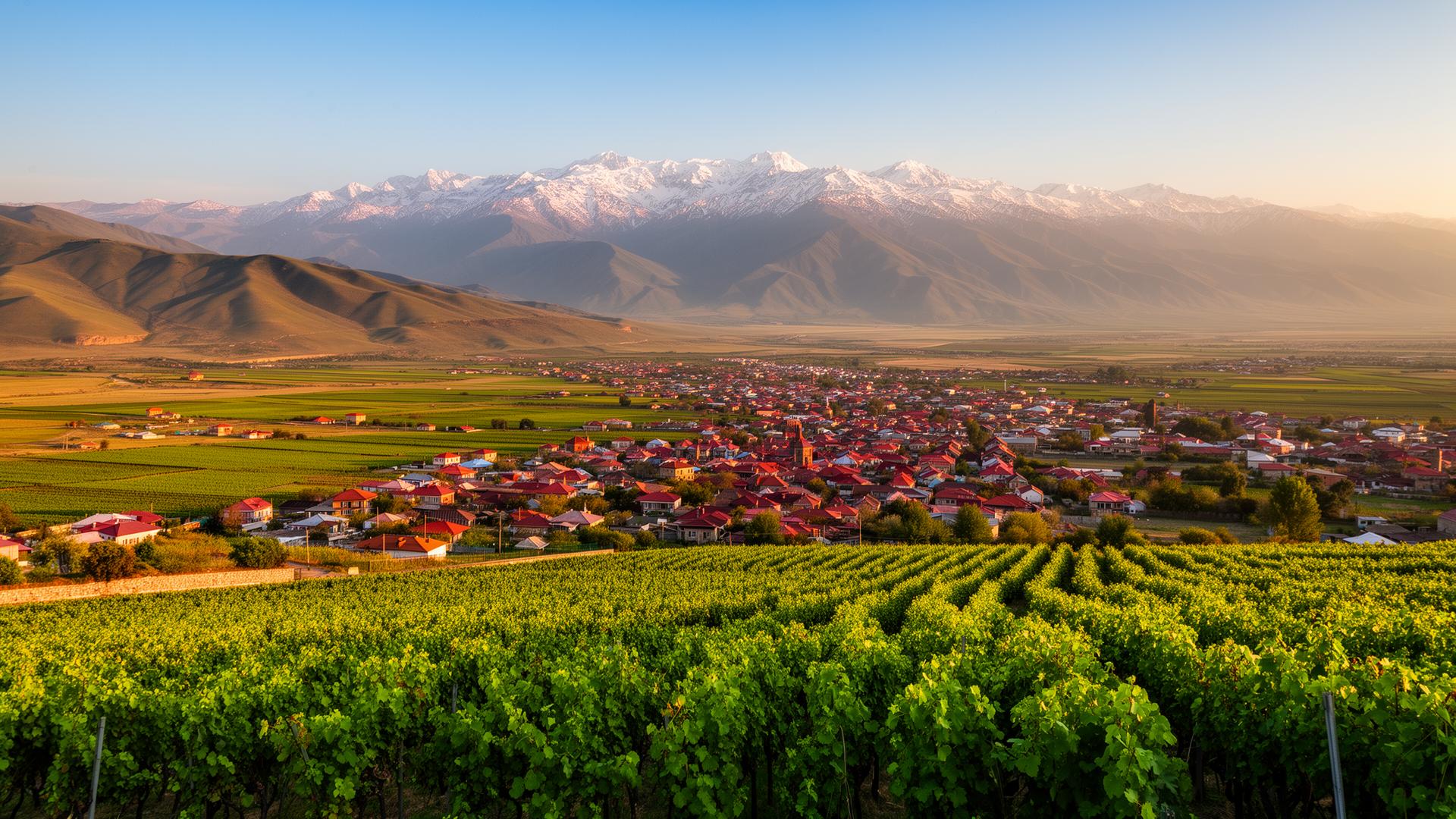
Eight thousand years ago, someone in what is now eastern Georgia crushed grapes, buried them in a clay vessel, and waited. That was the beginning of wine as we know it. Today, the Kakheti region where it happened is still Georgia's undisputed heartland of winemaking, producing roughly 70% of the country's output from vineyards that carpet the Alazani Valley floor.
But Kakheti is far more than a wine destination. The region holds some of Georgia's most significant medieval monasteries, a fortress city with 900-year-old plane trees, a bazaar that rivals anything in Central Asia, and a food culture built around slow meals, generous hosts, and the belief that a guest is a gift from God.
Here is our complete driving guide to Kakheti, built around Telavi as a base.
Getting There: The Gombori Pass
The most dramatic approach to Kakheti is from Tbilisi via the Gombori Pass. The 95 km drive takes about two hours and climbs through dense forest to 1,600 metres before descending into the Alazani Valley. The road is fully paved and manageable in any vehicle, though it has tight hairpin bends that require steady driving.
An alternative route runs through the lowlands via Sagarejo, which is faster but far less scenic. We recommend Gombori on the way in and the lowland route on the way back, or vice versa.
If you are arriving from the east, our Tbilisi-to-Yerevan route passes through southern Kakheti and can easily be combined with this itinerary.
Telavi: Your Base in Wine Country
Telavi is Kakheti's largest city and the best single base for exploring the region. It sits on a hillside at the foot of the Gombori Mountains, looking directly across the Alazani Valley toward the snow-capped Greater Caucasus. The view from the city's hilltop parks is one of the finest urban panoramas in the country.
What makes Telavi special is that it has not been built for tourists. Unlike the postcard-perfect walled town of Sighnaghi further south, Telavi has the atmosphere of a large village that happens to contain a 17th-century fortress, heritage streets lined with carved wooden balconies, and one of the liveliest covered markets in the Caucasus.
The Fortress and Royal Palace
Batonis Tsikhe, the "Master's Fortress," dominates the centre of Telavi. Built in the 1660s in a Persianate style inspired by Iranian palatial architecture, it contains a royal palace, a church, defensive towers, and a modern underground museum. The palace interior features coloured glass windows and decorative mirrorwork that connect it stylistically to Persian and Azerbaijani court architecture.
The History Museum within the fortress grounds is genuinely excellent. The ethnographic section covers Kakhetian textile traditions, vintage winemaking equipment, and archival photographs. A separate gallery holds a remarkable private art collection donated by a Telavi resident, with canvases by Georgian painters depicting everyday Kakhetian life.
Cholokashvili Street and the Old Quarter
The most photogenic walking route in Telavi follows Cholokashvili Street, a cobblestone lane where nearly every building has been restored. Carved wooden balconies in turquoise, green, and white overhang the street, and a handful of creative studios, ceramics workshops, and wine bars have opened in the ground floors.
The nearby Erekle II Street climbs westward past a mix of heritage homes and monolithic Soviet-era apartment blocks. A statue of King Erekle II on horseback guards the approach to the fortress, and the adjacent park shelters a 900-year-old plane tree with a trunk circumference of 12 metres.
The Telavi Bazaar
The covered market in central Telavi is one of the great market experiences in the Caucasus. Rows of stalls run beneath a curved metal roof, selling fresh produce, wheels of local cheese, churchkhela (grape-and-walnut candy), dried fruits, spice blends, and bottles of homemade wine. The hardware section is worth browsing for the atmosphere alone. Visit in the morning for the full experience.
Day Trips from Telavi
The Monastery Circuit (Half Day)
Three of Kakheti's most important monasteries sit within a 30 km radius of Telavi and can be visited in a single morning:
- Alaverdi Cathedral: One of the tallest religious structures in Georgia, this 11th-century cathedral stands alone in the valley floor surrounded by vineyards. The monastery produces its own wine, available for tasting at the gate.
- Ikalto Academy: Founded in the 6th century and expanded in the 12th century into a renowned centre of learning. The philosopher David the Builder studied here. The atmospheric ruins sit among ancient trees.
- Old and New Shuamta: Two separate monastery complexes on the same wooded hillside. Old Shuamta dates to the 5th century and is one of the earliest Christian structures in Georgia. New Shuamta is a working convent with frescoed walls.
All three are accessible on paved roads. No entrance fees, but modest dress is required.
Tsinandali and the Wine Estates (Half Day)
Tsinandali, a 15-minute drive from Telavi, is the historic seat of the Chavchavadze family, who pioneered European-style winemaking in Georgia in the 19th century. The estate includes a restored palace, formal gardens, and a wine cellar with bottles dating back over a century.
The area around Tsinandali is dotted with family wineries and larger estates offering cellar tours and tastings. Most operate without appointment, but calling ahead guarantees a more personal experience. Look for qvevri wine: the traditional Georgian method of fermenting grapes in buried clay vessels produces amber wines with a depth and texture unlike anything from a conventional cellar.
Sighnaghi (Full Day)
An hour south of Telavi, the hilltop town of Sighnaghi is Kakheti's most visually dramatic settlement. Its 18th-century defensive walls encircle a compact grid of pastel-coloured houses with views over the Alazani Valley. The Bodbe Monastery, where Georgia's patron saint Nino is buried, sits just outside town.
Sighnaghi is popular with day trippers from Tbilisi, so it can feel busy. Visiting from Telavi rather than the capital gives you a quieter experience and lets you arrive before the tour buses.
What to Eat and Drink
Kakheti's food culture revolves around wine, bread, and generosity. A typical Kakhetian meal is a supra (feast) with multiple courses, constant toasts, and more food than any table should hold.
- Mtsvadi: Vine-grilled pork or beef skewers, the Kakhetian barbecue tradition. Best eaten outdoors at a family marani.
- Kakhetian khachapuri: A flatter, crispier variation baked in a tone oven, different from the boat-shaped Adjarian version.
- Churchkhela: The "Georgian Snickers" — walnuts or hazelnuts dipped in thickened grape juice and air-dried. Telavi's bazaar has the freshest supply in the country.
- Saperavi: The king of Georgian red grapes. Deep, inky, tannic wines that improve with age. Every family in Kakheti makes their own.
- Amber wine: White grapes fermented on their skins in clay qvevri for months. The result is an amber-coloured, complex wine with a dry, almost tannic finish. This is the original Georgian winemaking method.
- Artisan cheese: Several Telavi cheese bars serve locally made hard and semi-soft varieties infused with wild garlic, truffle, and herbs.
Driving Conditions
Kakheti has good road infrastructure. The main highways connecting Telavi, Sighnaghi, Kvareli, and Gurjaani are all paved and well-maintained. The Gombori Pass road is sealed but winding. Side roads to individual wineries and villages range from smooth asphalt to packed gravel.
A standard sedan handles everything on this itinerary comfortably. If you plan to explore unpaved vineyard tracks or continue into the mountains of Tusheti (accessible only by 4x4), an SUV is recommended.
Parking is free and easy throughout Telavi and at all the monasteries and estates mentioned here.
When to Visit Kakheti
- Late September to October: Rtveli, the annual grape harvest. The most atmospheric time, with families picking grapes and crushing them in traditional marinas. Many wineries require advance booking during this period.
- April to June: Warm, green, wildflowers in the hills. Excellent for driving and outdoor tastings. For wildflower specifics, see our seasonal bloom guide.
- November to March: Quieter, cooler, crystal-clear mountain views. Some smaller wineries reduce hours, but the major estates operate year-round. Winter is actually a wonderful time for photography.
- July to August: Hot. Temperatures regularly exceed 35°C. Not ideal for extended outdoor exploration.
Renting a Car for Kakheti
We deliver free anywhere in Tbilisi, including Tbilisi Airport. No deposit, unlimited mileage, and prices from €30/day. The drive to Telavi is straightforward and having your own car transforms the experience, letting you visit multiple wineries, monasteries, and villages at your own pace.
Kakheti combines naturally with a Kvemo Kartli loop on the return to Tbilisi, or with a continuation north into the mountains toward Gudauri. For more Georgian road trip ideas, browse our top destinations guide.