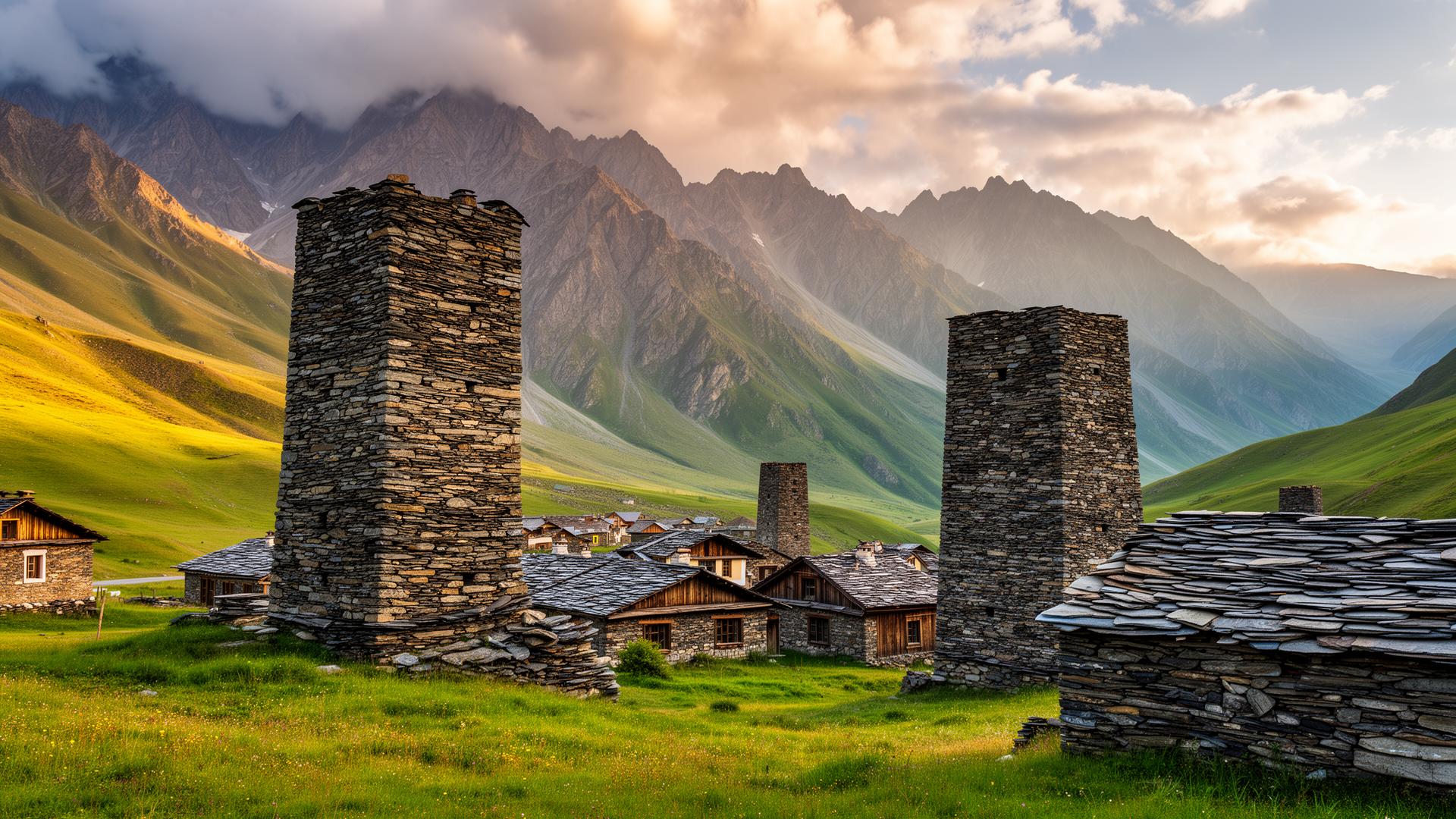
Tusheti is the place Georgians talk about in hushed tones. Tucked into the northeast corner of the Greater Caucasus, bordering Dagestan and Chechnya, this cluster of 48 stone-and-slate villages sits above 1,800 metres and is accessible by a single unpaved road that opens for roughly four months a year. Most visitors to Georgia never make it here. Those who do tend to call it the highlight of their trip.
The draw is straightforward: ancient defensive towers rising from green alpine meadows, a living pastoral culture built around seasonal sheep migration, a belief system that blends pagan shrines with Orthodox chapels, and some of the most dramatic mountain scenery anywhere in the Caucasus. Getting there, however, is the adventure in itself.
The Abano Pass: The Drive of a Lifetime
The road to Tusheti begins in Pshaveli, a small town in Kakheti, and climbs 70 km over the Abano Pass at 2,926 metres before descending into the Tusheti valley. It is entirely unpaved, carved into exposed mountainsides with sheer drops, no guardrails, and sections barely wide enough for a single vehicle. Waterfalls cascade directly across the road surface in several places.
The drive takes 3.5 to 4 hours from Pshaveli to Omalo. Combined with the 2 to 2.5 hour drive from Tbilisi to Pshaveli via the Gombori Pass, the full journey is a solid 6-hour commitment.
This is not a road for inexperienced mountain drivers. It requires a proper 4x4 with high clearance, low-range gearing, and confidence on exposed switchbacks. Some corners require reversing to complete the turn. There are no petrol stations, no phone signal for long stretches, and no recovery services between the trailhead and Omalo.
What Vehicle Do You Need?
A full-size 4x4 is mandatory. Our Toyota 4Runner and Jeep Wrangler both handle the Abano Pass confidently. The Toyota FJ Cruiser is another excellent choice. No sedan, crossover, or AWD vehicle should attempt this road.
We are one of the few rental companies in Georgia that permit our 4x4 vehicles on the Tusheti road with our full off-road insurance option. This matters, because a breakdown on the Abano Pass without coverage is an expensive problem.
What to See and Do in Tusheti
Omalo: The Gateway Village
Most visitors base themselves in Omalo, the first significant settlement you reach after crossing the pass. The village is split into Lower Omalo (the main cluster of guesthouses, a few shops, and a police station) and Upper Omalo, where the restored Keselo Fortress commands a ridge with views across the entire valley.
Keselo is one of the most photographed spots in Tusheti. The cluster of reconstructed stone towers silhouetted against the peaks at dawn or dusk is genuinely spectacular. The fortress was originally built as a last line of defence against invaders from the north.
Dartlo: The Architectural Jewel
Dartlo, about 30 minutes' drive west of Omalo on a rough valley road, is the most visually striking village in Tusheti. Its clan towers have been carefully restored, and the stone-and-wood houses with carved balconies sit against a backdrop of jagged peaks. A handful of guesthouses operate here in summer, and the village is small enough to explore on foot in an hour.
From Dartlo, hiking trails lead further west to Kvavlo and Dano, two even smaller settlements with fewer visitors and wilder scenery.
Shenako: The Green Village
Shenako sits in a pastoral valley and has a softer, more agricultural feel than the tower villages. It is the only settlement in Tusheti connected to the electricity grid (via a small hydropower plant). The 19th-century church on the hillside above the village has faded but atmospheric frescoes, and the surrounding meadows are carpeted with wildflowers in June and July.
Diklo: The Border Village
East of Omalo, the road to Diklo follows the valley toward the Russian border. The village is one of the most remote in Tusheti and sees very few visitors. A Georgian border police station operates nearby. Carry your passport at all times in this area.
Hiking in Tusheti
Tusheti has over a dozen marked trails ranging from short day loops to multi-day traverses. The most popular routes connect the main villages: Omalo to Dartlo (4-5 hours), Omalo to Shenako (3-4 hours), and the longer Dartlo to Parsma trail that crosses high passes with views into Dagestan.
Multi-day hikes require proper equipment, navigation skills, and awareness of mountain weather. There are no mountain huts between villages, and conditions can change rapidly. Solo hiking on longer routes is not recommended.
Sheepdog encounters are a real concern on trails. The Caucasian shepherd dogs guarding flocks are large, territorial, and trained to be aggressive. If you meet one, stop moving, speak calmly, and wait for the shepherd to call the dog off. Do not run.
Cultural Etiquette
Tusheti has distinct cultural customs that visitors should respect:
- Sacred shrines (Khati): Scattered across the landscape, these pagan-origin shrines are central to Tushetian spiritual life. Women are not permitted near men's shrines, and visitors of all genders should avoid approaching unless explicitly invited.
- No pork: Pork is considered taboo in the mountains (though Tushetians eat it freely in the lowlands). Do not bring pork products into the region.
- Dress conservatively: Covered shoulders and knees for all visitors. This is a rural mountain community with traditional values.
- Horses through villages: Dismount and lead your horse when passing through a village. Riding through was historically associated with invading armies.
What to Eat
- Guda cheese: Tusheti's signature product. Sheep's milk cheese aged in a sheepskin bag, giving it a distinctive tangy, slightly gamey flavour. Available at every guesthouse and celebrated at the annual cheese festival in Akhmeta.
- Khinkali: Mountain-style dumplings filled with beef and thyme. Every family has their own technique.
- Aludi (Tushetian beer): A mildly alcoholic barley beer brewed in most households. Offered to guests as a welcome drink.
- Kotori: A Tushetian flatbread filled with cheese and herbs, cooked on a stone griddle.
- Dried meat: Beef or mutton preserved for the long winters, served sliced alongside cheese and bread.
Practical Information
- Season: The Abano Pass typically opens in mid-June and closes in late September or early October, depending on weather. Check conditions before departing.
- Accommodation: Family guesthouses in every main village. Most include breakfast; dinner is extra. Book ahead for July and August. Many guesthouses only take bookings by phone or Facebook message.
- Cash only: There are no ATMs, banks, or card payment in Tusheti. The nearest ATM is in Alvani. Bring enough Georgian lari for your entire stay.
- Electricity: Solar-powered in most villages. Enough to charge phones and cameras, not enough for hairdryers. Bring a power bank.
- Phone signal: 4G coverage from Magti works in most main villages. No signal on much of the Abano Pass road.
- Fuel: No petrol stations in Tusheti. Fill up completely in Alvani or Pshaveli before starting the climb.
- Duration: Plan a minimum of 3 nights (2 full days). Add extra days for hiking or visiting multiple villages.
When to Go
- Mid-June to early July: Road opens, wildflowers peak, some guesthouses still setting up for the season. Quieter.
- July to August: Peak season. Best weather for hiking. Tushetian festivals including Atnigenoba (harvest celebration) in August.
- September: Autumn colours begin. Cooler nights. The transhumance (mass sheep migration to the lowlands) happens in late September and early October.
For broader seasonal planning, see our Georgia season guide.
Renting a 4x4 for Tusheti
We deliver free anywhere in Tbilisi and at Tbilisi Airport. Our 4x4 fleet includes the Toyota 4Runner, Jeep Wrangler, and FJ Cruiser, all permitted on the Tusheti road with our off-road insurance package. No deposit, unlimited mileage.
Tusheti combines naturally with a Kakheti wine country loop on the way back, or you can continue exploring Georgia's mountain regions with our Svaneti guide or Racha itinerary. For the full list of off-the-beaten-path ideas, see our hidden gems guide.