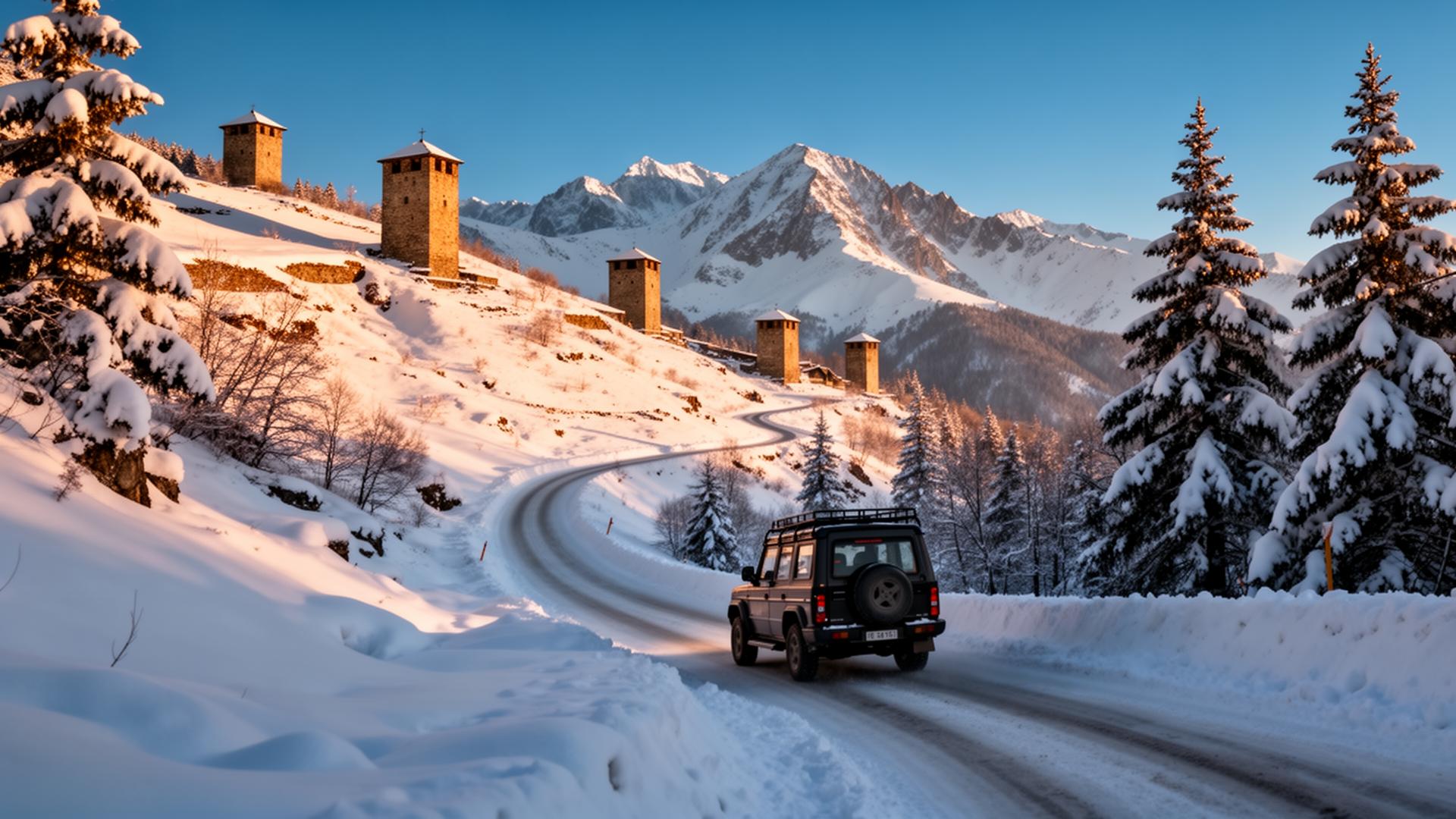
Georgia is steadily earning its reputation as one of Europe's most underrated winter destinations. Four ski resorts with lift passes under $20, volcanic plateaus frozen solid under vast skies, medieval tower villages dusted in powder, natural hot springs steaming against cold mountain air, and a festive calendar that stretches from New Year's Eve fireworks to Orthodox Epiphany ice plunges in January.
Winter is also the off-season, which means lower accommodation prices, empty roads, and a pace of travel that feels genuinely unhurried. The trade-off? Some remote mountain passes close until spring, and shorter days require tighter planning. But everything from Tbilisi to the ski slopes to the wine regions stays open and welcoming.
This guide covers the best winter experiences across the country, month-by-month weather, driving tips, key dates, and practical advice for planning your cold-season trip.
Winter Weather by Month
December
In Tbilisi, temperatures hover around 2–8°C during the day with occasional frost overnight. Snow is rare in the capital but common in the hills above the city. Mountain resorts receive their first reliable snowfall, with ski season officially opening around December 27 at Gudauri, Bakuriani, Mestia, and Goderdzi. Batumi stays relatively mild (5–10°C) with heavy rain.
January
The coldest month. Tbilisi averages 0–5°C with clear, dry skies. Mountain areas like Svaneti and Kazbegi see heavy snow and sub-zero temperatures (as low as -20°C in Mestia). The Javakheti Plateau in southern Georgia becomes a frozen landscape. This is peak ski season and the busiest period at resorts.
February
Conditions mirror January but with slightly longer days. Snow coverage is at its deepest in the mountains. Late February occasionally brings surprise snowfall to Tbilisi. The Lamproba fire festival in Svaneti falls on February 14. By late February, the first signs of spring appear in the lowlands.
Key Winter Dates and Holidays
- Mid-December – January 7: Christmas lights and holiday markets across Tbilisi
- ~December 27: Official opening of ski season at all four resorts
- December 31: New Year's Eve (Georgia's biggest celebration of the holiday season)
- January 1: New Year's Day (public holiday)
- January 2: Bedoba (public holiday)
- January 7: Orthodox Christmas Day (public holiday). Alilo processions in Tbilisi and other cities
- January 14: Orthodox Old New Year (public holiday)
- January 19: Orthodox Epiphany (public holiday). Natlisgheba ice-bathing ritual on Paravani Lake
- February 14: Lamproba bonfire festival in Mestia and across Svaneti
For a full annual breakdown, see our Georgia festivals calendar.
On the Slopes: Four Ski Resorts Under $20 a Day
Georgia's four government-run ski resorts offer some of the most affordable alpine skiing in the world. Lift passes average around $20 per day, equipment rental runs about $15, and the slopes are blissfully free of the queues you find in the Alps.
Gudauri
The most popular resort, just 2 hours north of Tbilisi on the Georgian Military Highway. Excellent for intermediate and advanced skiers, with night skiing, backcountry access, and heliskiing options. The New Gudauri development has modern hotels and the spectacular Kobi-Gudauri Cable Car with panoramic views of Mount Kazbek.
Bakuriani
A family-friendly resort in the Borjomi Valley with gentler slopes spread across two areas (Didveli and Kokhta-Mitarbi). Good for beginners. Combine with a visit to snowy Borjomi for hot springs and historic architecture.
Tetnuldi and Hatsvali (Mestia)
The most scenically dramatic resort, set beneath the towers of Svaneti. Tetnuldi has the best variety of runs and stunning panoramas. Hatsvali is smaller but has a charming mid-station with Samoyed dog sledding. Getting to Mestia requires a longer drive, but the medieval tower villages in deep snow are unforgettable.
Goderdzi
The most adventurous option, located above Batumi in Adjara. Access is via snowcat from the Khulo side. Remote, quiet, and perfect for freeriders looking for untouched powder.
Driving the Frozen Javakheti Plateau
The Javakheti Plateau in southern Georgia is a volcanic highland of vast, treeless landscapes, frozen lakes, and isolated monasteries. In winter, the elevated terrain is completely iced over, earning it the nickname "the Georgian Arctic."
Ribbon roads stretch across empty white plains past communities of Georgian, Armenian, Azerbaijani, and Doukhobor descent. The main attractions are Paravani Lake (Georgia's largest), the medieval Poka Monastery, and the atmospheric town of Akhalkalaki. Time your visit for January 19 to witness the Natlisgheba ice-bathing ritual on Paravani Lake.
A 4x4 with winter tyres is essential. The roads are maintained but can be treacherous after snowfall. For route details, see our Samtskhe-Javakheti driving guide.
The Georgian Military Highway in Snow
The historic Military Highway from Tbilisi to Kazbegi is magnificent in winter. Snow blankets the Ananuri Fortress, the Gudauri viewpoint, and the Jvari Pass. The Dariali Gorge near the Russian border is particularly dramatic against a winter backdrop.
Be aware that this road is prone to closures from avalanche risk, sometimes lasting several days. Check the Geo Road Facebook page before departing. Winter tyres are mandatory on mountain roads from December 1 to March 1. See our Gudauri transport guide for full details.
Svaneti's Towers Under Snow
While Tusheti and Khevsureti are sealed off until summer, Svaneti stays accessible year-round. The iconic fortified tower-houses of Mestia and Ushguli are stoic and beautiful dressed in snow. Museums, restaurants, and guesthouses remain open throughout winter.
The drive to Mestia can be challenging in bad weather, with occasional closures during storms. But the reward is one of Europe's most dramatic winter landscapes. The road to Ushguli is now fully sealed, making it possible to visit even in deep winter. Just note that the alternative road through Lentekhi is summer-only.
Snowshoe Trekking in the Caucasus
Summer hiking trails are buried under metres of snow, but guided snowshoe expeditions open up a different side of the Greater Caucasus. The Sioni Valley near Kazbegi, the forests around Bakuriani, and sections of the famous Mestia-to-Ushguli route are all viable with snowshoes and an experienced guide.
Avalanche risk is real in the mountains. Never attempt winter trekking without a local guide who knows the terrain. For lower-altitude walking, Borjomi-Kharagauli National Park and trails near Tbilisi (Sabaduri Forest, Kojori) may be clear of deep snow in December and early January.
Natural Hot Springs and Sulfur Baths
Nothing pairs with a cold Georgian winter day like steaming thermal water. Beyond the famous Abanotubani sulfur baths in Tbilisi, natural hot springs dot western Georgia.
- Borjomi Central Park: Open-air thermal pools that were once the private baths of the Romanov family
- Vani Sulfur Spring: A natural pool near Kutaisi with mineral-rich water
- Nokalakevi: Hot springs beside a 4th-century fortress
- Sairme: A mountain spa resort with multiple mineral water sources
Winter is the best season for these springs. Cool air makes the warm water feel even more restorative, and you can alternate between the heat and fresh snow for a natural contrast bath.
Frozen Forests and Snow Day Trips from Tbilisi
Snow is rare in central Tbilisi (typically just 2–3 snowy days per winter), but drive 30 minutes into the surrounding hills and the landscape transforms. Popular winter day trips:
- Sabaduri Forest: Thick coniferous forest draped in white powder, under an hour from the city. Safe parking area for snow play
- Shaori Lake (Racha): A frozen reservoir surrounded by snow-covered forest. Pair with Nikortsminda Cathedral
- Udabno Rainbow Hills: The semi-desert southeast of Tbilisi stays dry and mild even in winter. Almond orchards may bloom as early as late February
- Gori and Uplistsikhe: The cave city and Stalin Museum make a solid winter day trip, often with snow in Gori when Tbilisi is dry
Winter Food: Cheese Fondue, Dumplings, and Mulled Wine
Georgian cuisine is built for cold weather. Hearty dishes that shine in winter include:
- Khachoerbo: Mountain-style cheese fondue made with sulguni and butter, served with bread for dipping. The best versions come from Kazbegi restaurants
- Khinkali: Georgia's beloved dumplings are perfect in any season but taste especially good steaming hot after a cold day on the slopes
- Chikhirtma: A rich chicken and egg soup, sour and warming
- Lobio: Slow-cooked spiced beans served in a clay pot, usually with cornbread (mchadi)
- Mulled Georgian wine: Full-bodied Saperavi spiced and warmed. Served at Tbilisi's Christmas markets and wine bars
For more dining recommendations, see our Tbilisi food guide.
Frozen Vineyards: Winter Wine Tasting in Kakheti
The Kakheti wine region stays open year-round. Larger cellars like Kvareli Wine Cave and Tsinandali Estate offer tours and tastings even in deep winter. Driving through the Alazani Valley when the vines are cut back to their stems and frost covers the fields is a completely different experience from the harvest-season crowds.
The hilltop town of Sighnaghi is especially peaceful in winter. Without the summer haze, views from the ancient walls stretch clearly to the snow-covered Greater Caucasus. Accommodation is significantly cheaper, and restaurants have space for walk-ins.
Tbilisi Holiday Markets and New Year's Eve
Christmas lights go up across Tbilisi from mid-December and stay until Orthodox Christmas on January 7. Holiday markets pop up around Rustaveli Avenue, First Republic Square, and the Fabrika creative hub. Local vendors sell handmade ornaments, churchkhela, mulled wine, and Georgian sweets.
New Year's Eve (December 31) is the biggest celebration of the Georgian holiday season. Tbilisi erupts with fireworks at midnight, visible from balconies and rooftops across the city. Restaurants offer special supras (feasts), and the streets fill with revellers well into the early hours.
The Alilo Procession: Orthodox Christmas (January 7)
On Orthodox Christmas Day, Tbilisi, Kutaisi, and cities across Georgia host the Alilo procession. Children and clergy in traditional robes parade through city streets singing Christmas hymns and collecting donations, converging on Sameba Cathedral in Tbilisi. A moving, family-friendly tradition open to all visitors.
Natlisgheba: Ice Bathing on Paravani Lake (January 19)
The most spectacular winter tradition in Georgia. On Orthodox Epiphany, a cross-shaped hole is cut into the frozen surface of Paravani Lake on the Javakheti Plateau. After a liturgical service at the lakeside monastery, dozens of believers plunge into the icy water. The ceremony is followed by a communal feast inside the monastery. Driving conditions require a capable 4x4.
Lamproba: Fire and Memory in Svaneti (February 14)
On the evening of February 14, families across Svaneti gather at village cemeteries to light bonfires beside the graves of their ancestors. The ritual is followed by feasting and wine. Witnessing Lamproba in Mestia, with bonfires glowing against a backdrop of snow-covered towers and mountains, is one of the most unforgettable experiences Georgia offers.
Soviet Relics and Winter Urbex
Bare trees and empty corridors make winter ideal for exploring Georgia's abandoned Soviet architecture. Key sites:
- Tskaltubo: Monumental sanatoriums in various states of abandonment and restoration, near Kutaisi
- Chiatura: The manganese mining town with vintage Soviet cable cars. Snow makes the mosaics and facades pop
- Zestafoni Path of Mosaics: Soviet-era tile murals along the main thoroughfare
- Sanatorium Libani (Borjomi): A recently rediscovered brutalist gem in the forest above Borjomi
Practical Tips for Driving in Winter
- Winter tyres are mandatory on mountain roads from December 1 to March 1. All FSTA 4x4 rentals come with winter tyres fitted during the cold season
- Check road closures daily. The Rikoti highway, the Military Highway, and mountain roads can close without notice. The Geo Road Facebook page is the best real-time source
- Keep flexible schedules. Major snowstorms occasionally shut down entire regions for several days
- Fill up before mountain drives. Fuel stations thin out outside major cities
- A 4WD is strongly recommended for any mountain destination in winter. For Tbilisi-only trips, a sedan works fine
For more driving advice, see our complete guide to driving in Georgia.
What to Pack for Winter in Georgia
- Warm coat, thermals, and layering pieces for mountain areas
- Waterproof boots with good grip
- Gloves, wool hat, and scarf
- In Tbilisi, jeans and a warm jacket are usually sufficient
- Base layers that dry quickly (tumble dryers are uncommon in Georgia)
- Sunglasses and sunscreen for mountain snow glare
For the full checklist, see our Georgia packing list.
Best Winter Road Trip Routes
- Georgian Military Highway — Tbilisi to Kazbegi via Gudauri (1–3 days). Snow-covered fortresses, ski slopes, and the Kobi-Gudauri Cable Car
- Javakheti Plateau Loop — Borjomi, Bakuriani, Paravani Lake, Akhalkalaki (3–4 days). Frozen lakes and the Natlisgheba ritual
- Svaneti Winter Drive — Zugdidi to Mestia and Ushguli (3–5 days). Medieval towers in deep snow, Tetnuldi skiing, Lamproba festival
- Kakheti Wine Loop — Sighnaghi, Telavi, Kvareli (2 days). Peaceful winter tastings and frosted vineyard drives
Browse our full car rental fleet or pick up from Tbilisi Airport, Kutaisi Airport, or Batumi Airport. No deposit, unlimited mileage, and free delivery.
Frequently Asked Questions
How cold does Georgia get in winter?
Tbilisi stays mild at 0–8°C. Mountain areas like Svaneti and Kazbegi drop well below freezing, with Mestia reaching -20°C in January. The Javakheti Plateau is similarly harsh. Western Georgia (Kutaisi, Batumi) stays warmer but wetter.
Does it snow in Tbilisi?
Rarely. Expect 2–3 snowy days per winter, usually in late February or early March. Snow rarely sticks for more than a day in the city centre. For guaranteed snow, head to any mountain destination.
When does ski season start and end?
The official season runs from approximately December 27 to late March, with exact opening and closing dates at each resort depending on snow conditions.
Can I drive to Kazbegi in winter?
Yes, but the Military Highway is prone to closures from avalanche risk. Check conditions before departing and travel with winter tyres and a 4WD vehicle. The new bypass tunnel will eventually ease access.
Are roads safe for driving in winter?
Major highways between cities are well-maintained. Mountain roads require winter tyres (mandatory Dec 1 – Mar 1) and ideally a 4WD. Avoid night driving on any mountain road. See our driving guide for details.
What is there to do in Georgia in winter besides skiing?
Hot springs, wine tasting in Kakheti, frozen lake excursions, Soviet architecture tours, snowshoe trekking, Tbilisi holiday markets, Orthodox Christmas and Epiphany festivals, and some of the best comfort food in the Caucasus.