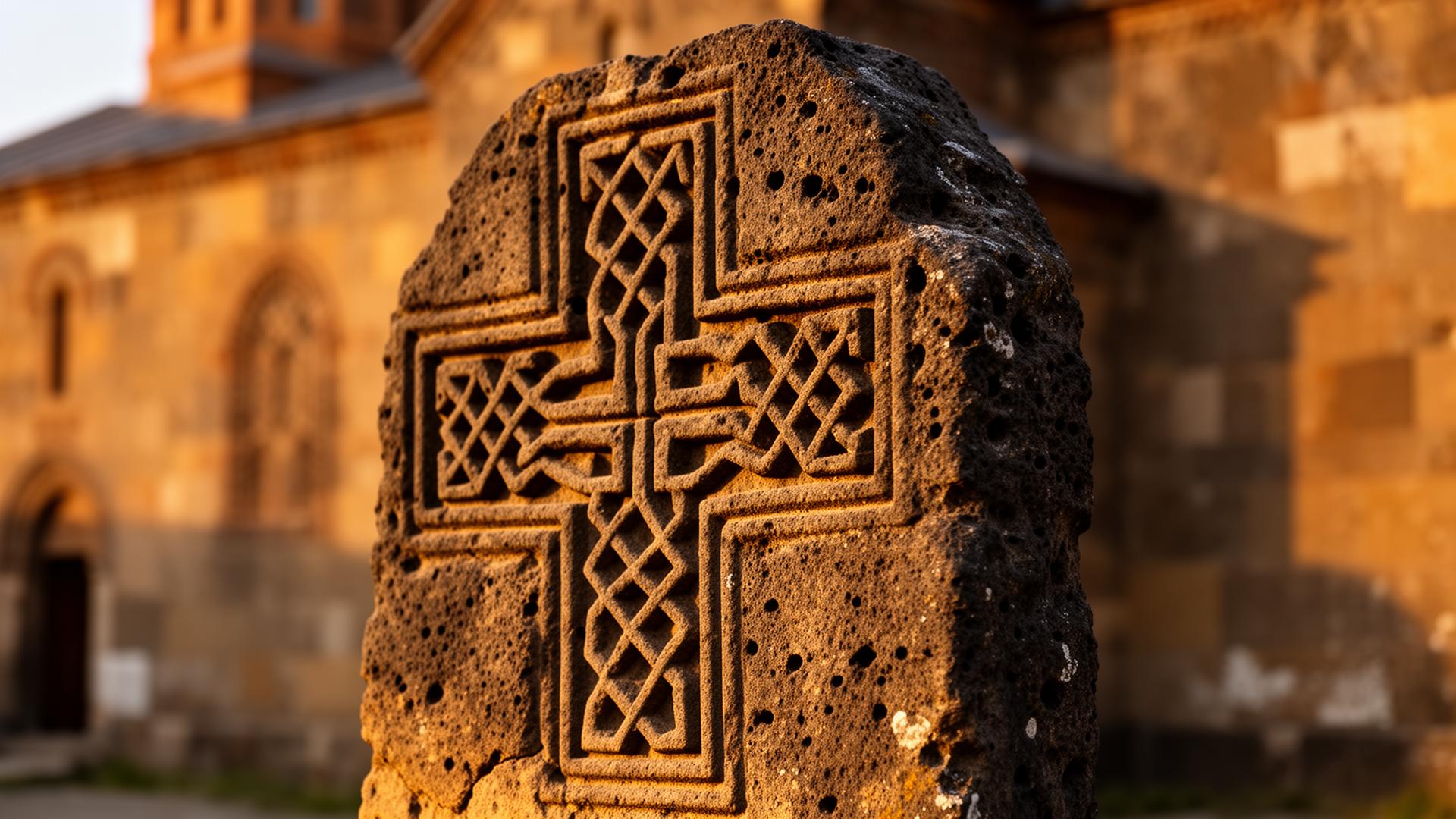
Most people arrive in Armenia expecting monasteries and mountains. They leave with something harder to articulate: a sense of having encountered a country that takes its own survival seriously, that treats its past not as a museum exhibit but as a living argument for why it still exists. Armenia is old in a way that most countries are not. Its alphabet was invented in 405 AD specifically to preserve its identity. Its churches were carved into cliff faces to withstand invasion. Its cuisine, its music, its art all carry a weight of continuity that you feel viscerally once you start driving through the landscape.
This is not a standard travel guide. We have those elsewhere: a Yerevan city guide, a Tatev driving route, a Debed Canyon monastery guide, and a 10 monasteries road trip. This post is about the context that makes those places meaningful, and why Armenia affects visitors differently than most destinations.
The First Christian Nation
Armenia adopted Christianity as its state religion in 301 AD, making it the first country in the world to do so, predating the Roman Empire's conversion by decades. This is not a trivia fact. It is the foundation of Armenian national identity, and it explains why the country has more monasteries and churches per square kilometre than almost anywhere on earth.
Gregory the Illuminator, who converted King Tiridates III, was imprisoned in a pit at Khor Virap for 13 years before performing the conversion. You can climb down into that pit today, a narrow stone shaft accessible by metal ladder, with Mount Ararat filling the horizon when you climb back out. Moments like that, where ancient narrative and physical landscape collide, happen constantly in Armenia.
The Armenian Apostolic Church is distinct from both Roman Catholicism and Eastern Orthodoxy. Its liturgy, its calendar, its theological positions are unique. When you visit Armenian monasteries, the architecture reflects this: conical domes, geometric carvings, and an austere interior aesthetic that prioritises stone and light over painted decoration.
The Alphabet as National Identity
In 405 AD, a monk named Mesrop Mashtots created the Armenian alphabet. He did not merely borrow from Greek or Aramaic. He invented 36 entirely new characters (later expanded to 39) specifically designed to capture the sounds of the Armenian language. The purpose was explicit: to translate the Bible into Armenian and to give the nation a written language that could not be absorbed by its more powerful neighbours.
The alphabet is everywhere in modern Armenia. Street signs, restaurant menus, tattoos, jewellery, public art. Near Artashavan on the road to Amberd Fortress, a field of giant stone letters stands on a hillside, each one representing a character of the alphabet, built to celebrate the script's 1,600th anniversary. It is one of the most photographed roadside stops in the country.
The Matenadaran in Yerevan houses one of the world's largest collections of ancient manuscripts, over 23,000, including illuminated Bibles, scientific treatises, and historical chronicles dating back to the 5th century. The building itself, a severe basalt edifice on a hill above the city, is a monument to the idea that a nation's identity lives in its written word.
The Genocide and the Diaspora
You cannot understand modern Armenia without understanding the events of 1915. The Armenian Genocide, carried out by the Ottoman Empire, resulted in the deaths of an estimated 1.5 million Armenians and the displacement of virtually the entire population from their ancestral lands in eastern Turkey. The genocide scattered survivors across the world, creating diaspora communities in Lebanon, Syria, France, the United States, Argentina, Australia, and dozens of other countries.
Today, fewer than 3 million people live in the Republic of Armenia. The global Armenian diaspora numbers approximately 7 million. This means the majority of Armenians live outside Armenia, a demographic reality that shapes everything from the country's politics to its cultural institutions to the emotional charge that many visitors feel when they arrive.
The Tsitsernakaberd Genocide Memorial in Yerevan sits on a hilltop overlooking the Hrazdan Gorge. The memorial complex, with its 12 slanting basalt slabs surrounding an eternal flame, is one of the most powerful monuments anywhere in the world. The adjacent museum presents the historical record with clarity and restraint. For many diaspora Armenians visiting for the first time, this is the emotional centre of their trip.
Heritage Tourism and Roots Travel
Armenia receives a significant number of visitors each year who are not tourists in the conventional sense. They are diaspora Armenians returning to a homeland they may never have visited, sometimes tracing family histories that were violently interrupted over a century ago. This form of travel, sometimes called heritage tourism or roots tourism, gives Armenia a layer of emotional intensity that few other destinations possess.
If you are driving through Armenia with a rental car, you will encounter this at monasteries, at the genocide memorial, at the Matenadaran, and sometimes in casual conversation with locals. The country's small size and the intimacy of its communities mean that connections form quickly. A family restaurant owner in Gyumri may ask where your grandparents were from. A monastery caretaker may unlock a room that is normally closed if you show genuine interest in the history.
What You Notice Driving Through Armenia
Armenia is a country of sharp contrasts, and driving is the best way to absorb them.
- The Ararat paradox: Mount Ararat, Armenia's most sacred national symbol, is visible from Yerevan on clear days but sits inside Turkey. Armenians live with this every day: the defining image of their homeland is across a closed border they cannot cross. Driving south from Yerevan toward Khor Virap, the mountain grows larger and more impossibly dramatic with every kilometre.
- Soviet and post-Soviet layers: Armenia was part of the Soviet Union until 1991. The evidence is everywhere: Brutalist apartment blocks, abandoned factories, faded murals, and an industrial infrastructure that is slowly being repurposed or reclaimed by nature. Gyumri in particular preserves this layered history, where 19th-century tuff-stone mansions sit beside earthquake-damaged Soviet housing.
- The earthquake: The 1988 Spitak earthquake killed 25,000 people and devastated northern Armenia. Gyumri and surrounding towns were largely destroyed. Some areas are still rebuilding. The earthquake shaped modern Armenia as profoundly as the genocide shaped its historical memory.
- Resilience as a national trait: Armenia has survived genocide, earthquake, Soviet collapse, war, and blockade. The country is landlocked, with two of its four borders closed (Turkey and Azerbaijan). Despite this, Armenians have built a functioning democracy, a growing tech sector, a vibrant arts scene, and a food and wine culture that punches far above its weight.
The Emotional Weight of Armenian Travel
Visitors to Armenia, whether they have Armenian heritage or not, frequently describe a quality of experience that is hard to find elsewhere. Part of it is the landscape: the gorges, the volcanic plateaus, the monasteries perched in impossible positions. Part of it is the food: lavash baked in underground tonir ovens, khorovats grilled over vine cuttings, pomegranate molasses drizzled on everything. Part of it is the people: generous, proud, direct, and deeply interested in where you come from and why you are here.
But the deeper pull is historical. Armenia does not treat its past as background decoration. It lives with it daily. When you stand inside Haghpat Monastery and realise it has been in continuous use for over 1,000 years, through Seljuk invasions, Mongol raids, Ottoman rule, Soviet suppression, and post-independence poverty, the concept of resilience stops being abstract and becomes architectural. The stones are the argument.
Practical Considerations for Cultural Visits
- Tsitsernakaberd Memorial: Free entry. The museum has a small fee (around 1,000 AMD). Allow 2 hours for the memorial and museum combined. Located on a hilltop in western Yerevan, accessible by taxi or a 30-minute walk from the city centre.
- Matenadaran: Entry fee around 1,500 AMD. Guided tours available in English. Photography restricted in some rooms. Allow 1.5 to 2 hours.
- Alphabet Monument: Free, open-air site on the road to Amberd. No facilities. Best combined with a visit to Saghmosavank Monastery and Amberd Fortress.
- Monasteries: All free to enter. Modest dress expected (shoulders and knees covered). See our monasteries driving guide for the full list.
- Local etiquette: Armenians are warm but direct. Accept offered food and drink graciously. Tip generously at restaurants (10% is appropriate). Ask before photographing people, especially at memorial sites.
How to Structure a Heritage-Focused Trip
If cultural depth is your priority, here is a suggested 7-day route by car:
- Day 1: Arrive in Yerevan. Tsitsernakaberd Memorial and museum. Evening walk through Republic Square.
- Day 2: Matenadaran in the morning. Cafesjian Museum of Art at the Cascade. Vernissage market for shopping.
- Day 3: Day trip to Geghard Monastery and Garni Temple. Alphabet Monument on the return drive.
- Day 4: Drive south to Khor Virap, Noravank, and Tatev. Overnight in Goris.
- Day 5: Drive north via Lake Sevan and Dilijan to Vanadzor.
- Day 6: Haghpat and Sanahin monasteries in the Debed Canyon.
- Day 7: Drive west to Gyumri. Explore the old town and earthquake memorial. Return to Yerevan or cross back into Georgia.
Frequently Asked Questions
Do I need Armenian heritage to appreciate these sites?
Not at all. The monasteries, landscapes, and cultural sites are compelling for any visitor. Having Armenian roots adds an emotional dimension, but the historical significance and sheer beauty of the sites speak for themselves.
Is the Genocide Memorial suitable for children?
The outdoor memorial is appropriate for all ages. The museum contains graphic historical photographs that may not be suitable for young children. Use your judgment.
How much time should I spend in Armenia for a cultural trip?
A minimum of 5 days covers Yerevan's cultural sites, one or two monastery excursions, and either the southern or northern route. Seven to 10 days allows a comprehensive cultural tour. See our Caucasus planning guide for combining with Georgia.
Can I drive to all the cultural sites?
Yes. Every site mentioned in this guide is accessible by car. Most roads are paved. A standard rental from Yerevan handles the routes. For remote mountain sites like Amberd, a 4x4 is recommended.
Is there a local guide service for heritage visitors?
Several organisations in Yerevan offer guided heritage tours, including genealogy-focused itineraries for diaspora visitors. The AGBU (Armenian General Benevolent Union) and Birthright Armenia programme both facilitate heritage visits. For independent travellers, a rental car combined with a local guide for specific sites offers the best balance of flexibility and depth.