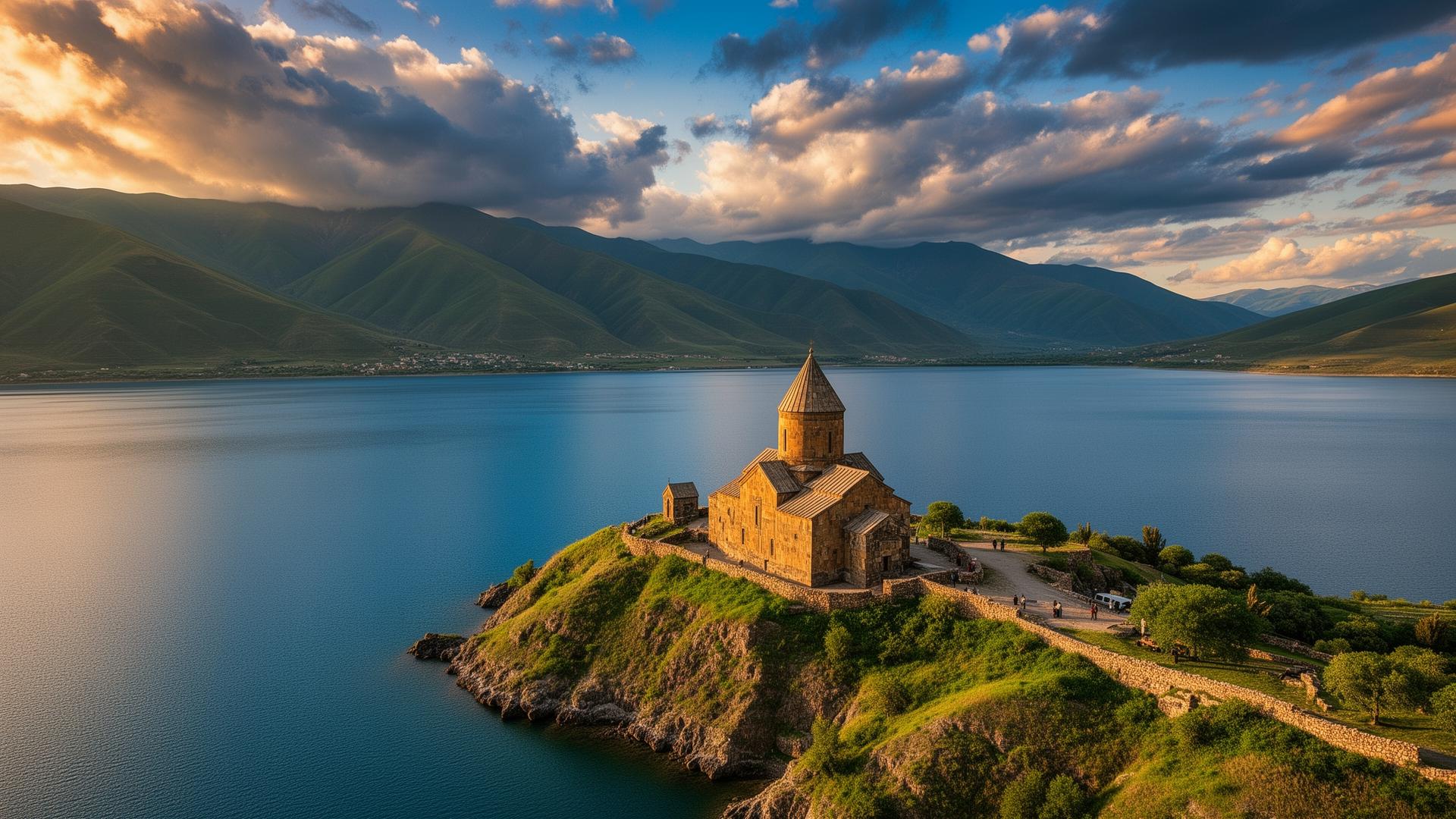
Armenia has dozens of reasons to visit, but Lake Sevan might be the single most versatile. At 1,900 metres above sea level, it is one of the largest high-altitude freshwater lakes in the world, a vast inland sea covering roughly five percent of Armenia's total surface area. The water shifts between deep sapphire and pale turquoise depending on the season and light, and the surrounding mountains create a microclimate that feels completely different from the lowlands just an hour away.
Most visitors see Sevan as a quick stop on the way between Yerevan and Dilijan. They drive up, photograph the monastery on the peninsula, eat some grilled fish at a roadside restaurant, and leave. That approach misses almost everything that makes the lake special.
With a rental car from Yerevan, you can spend a full day — or better yet, two — circling the lake, stopping at hidden beaches, visiting ancient cemeteries with carved stone crosses, exploring one of the most unusual Soviet buildings in the Caucasus, and eating freshly caught crayfish at family-run spots along the southern shore.
This guide covers the full loop, broken into sections, with driving times, road conditions, and practical tips.
Getting to Lake Sevan from Yerevan
The drive from Yerevan to the Sevan Peninsula takes about one hour on the M4 highway. The road is a divided motorway for most of the way, smooth and well-maintained. You climb steadily through dry, treeless hills before cresting a pass and seeing the lake spread out below you — it is a genuinely dramatic first impression.
From Zvartnots Airport, add 20 minutes. From Tbilisi via the cross-border route, Sevan sits about two hours south of the Georgian border at Bavra, making it a natural first or last stop on a combined Georgia-Armenia road trip.
Any car handles the main highway. A sedan like the Hyundai Elantra is perfectly fine for the paved roads around the lake. For exploring unpaved side roads to remote beaches and cemeteries on the eastern shore, a higher-clearance vehicle like the Toyota 4Runner is more comfortable.
The Sevan Peninsula and Sevanavank Monastery
The most visited spot on the lake is the Sevan Peninsula on the northwestern shore. This rocky outcrop was originally an island — a tunnel bored in the 1930s for irrigation and hydroelectric power caused water levels to plunge by up to 20 metres, exposing a three-kilometre land bridge that turned the island into a peninsula. Later restoration projects stabilised the water, but the landscape had already been permanently reshaped.
Two small churches — Surp Arakelots (Church of the Holy Apostles) and Surp Astvatsatsin (Holy Mother of God) — stand on the hilltop. The larger church was built in 874 AD by monks who had arrived on the island a century earlier. The complex dates to the 4th century, making it one of the oldest monastic foundations in Armenia, established shortly after Christianity became the state religion. Dark volcanic basalt gives the buildings their brooding character and earned the monastery its name: Sevanavank, meaning "the Black Monastery."
The churchyard is scattered with beautifully carved khachkars (stone crosses), and inside the larger church you can find a rare carved relief depicting the face of Christ with distinctively almond-shaped eyes — a stylistic choice some historians believe was intended to discourage Mongol invaders from destroying the image.
Climb the 200-odd steps to the top for panoramic views in every direction. Early morning is best — tour buses from Yerevan typically arrive between 11am and 2pm, so getting there by 9am gives you the peninsula almost to yourself. From the hilltop, a path continues east along the ridge to a scenic viewpoint with even wider vistas of the open water and surrounding mountains.
At the base of the peninsula you will find souvenir stalls, a car park, and several restaurants specialising in grilled trout and crayfish. Quality varies. The restaurants with lake-facing terraces charge a premium but the views justify it.
Vazgenyan Seminary and Surb Hakob Chapel
On the northern slope of the peninsula, below Sevanavank, sits a working theological seminary — the Vazgenyan Theological Academy, founded in 1990. Its courtyard contains the small Surb Hakob Chapel. The seminary grounds are closed to the public, but you can look down over the U-shaped building and chapel from the winding path that leads up to the monastery.
Presidential Residence — Restricted Area
Note that the eastern end of the peninsula houses a summer residence for the Armenian president. The area is fenced and off-limits; photography in that direction is prohibited. Stay on the main paths and you will not accidentally wander in.
The Sevan Writers' House: Soviet Modernism on the Water
On the southern edge of the peninsula sits one of the most striking pieces of Soviet architecture in the entire Caucasus. The Writers' House was built in 1933 as a retreat for the Armenian Writers' Union — a place where poets, novelists, and translators from across the Soviet Union could gather, collaborate, and work beside the lake.
The complex has two parts. The older Residence Hall is a four-storey Constructivist building embedded in the cliff face, designed by architects Gevorg Kochar and Mikael Mazmanyan in 1932. The more recognisable structure — a dramatic curved glass-and-concrete pavilion that appears to hover over the water — is the Lounge, added in 1963 by the same architects after they returned from political exile in Siberia.
The building has not been heavily restored, which is part of its appeal. It operates as a small hotel with basic rooms and a functioning cafe inside the Lounge. Hotel guests get access to areas the public cannot reach, and eating breakfast as morning light floods through the panoramic windows is one of the most memorable experiences at Sevan. Even if you do not stay overnight, you can visit the cafe for a coffee — though staff have been known to ask non-guests to leave, so ordering something is advisable.
Architecture enthusiasts and photographers should budget at least an hour here. The cantilevered Lounge is best photographed from the road below the peninsula, where it appears to float above the shoreline like a landed spacecraft.
Driving the Northern Shore: Sevan to Dilijan
Heading east from the peninsula along the M4, you follow the northern shore toward Dilijan. This is the busiest stretch because it carries through-traffic between Yerevan and the northern provinces.
The road hugs the lakeshore for the first 20 kilometres before climbing away toward the Dilijan Pass. Several pull-offs let you stop for photographs — the views back toward the peninsula with the monastery silhouetted against the water are excellent in late afternoon light.
Hayravank Monastery
About 15 minutes east of Sevan town, a signed turnoff leads down to Hayravank, a 9th-century monastery perched on a grassy bluff directly above the lake. Unlike Sevanavank, Hayravank receives almost no visitors. You will likely have the site entirely to yourself.
The church is small but beautifully proportioned, with carved reliefs above the entrance. The surrounding cemetery contains dozens of khachkars — the intricately carved stone crosses that are one of Armenia's most distinctive art forms and a UNESCO-recognised tradition. Some here date to the 10th century.
There is no entrance fee and no guard. Just park at the edge of the field and walk across. The setting — ancient stones, blue water, silent mountains — is one of the most atmospheric in Armenia.
The Dilijan Detour
If you continue past Sevan toward Dilijan (another 40 minutes through a mountain tunnel), you reach Armenia's so-called "Little Switzerland" — a forested mountain town with restored 19th-century architecture, craft workshops, and hiking trails into Dilijan National Park. It makes an excellent overnight stop if you are doing a two-day Sevan circuit.
The Eastern Shore: Empty Roads and Stone Crosses
The eastern shore of Lake Sevan is where the crowds disappear entirely. A two-lane road runs along the waterline through small farming villages, past pebbly beaches, and alongside stretches of marshland where migratory birds gather in spring and autumn.
This is the most rewarding section for drivers who enjoy the journey as much as the destination. Traffic is light, the road is paved but quiet, and the landscape shifts between open grassland and volcanic hillsides.
Noratus Cemetery
The village of Noratus, about 30 minutes south of Sevan on the eastern shore, holds the largest collection of khachkars in Armenia — nearly 900 carved stone crosses spread across a grassy field. The oldest date to the 10th century; the most elaborate are from the 13th to 17th centuries.
Each khachkar is unique, carved with geometric patterns, floral motifs, hunting scenes, and religious imagery. Walking through the field feels like wandering through an outdoor museum of medieval Armenian art. There is a small entrance fee and a caretaker who may offer an informal tour.
Noratus gained renewed significance after the destruction of thousands of khachkars at the Julfa cemetery in Nakhchivan. It is now the single largest surviving collection of these monuments anywhere in the world.
Wild Beaches and Water Sports
Between Noratus and Martuni, several unpaved tracks lead down to rocky and pebbly beaches that see almost no visitors. The water at Sevan's altitude is cold year-round — swimmable from late June through August for the brave — but the solitude is the real draw. Bring a picnic and enjoy the silence.
For something more active, a PADI diving club on the eastern shore offers guided freediving, scuba, and snorkelling expeditions to explore underwater rock formations beneath the lake's surface. SUP boards, kayaks, and sea bikes are also available for rent during the summer season. Jetski and boat hire pop up along the western shore beaches near the peninsula from June onward.
The Southern Shore: Crayfish and Volcanic Landscapes
The southern end of the lake around Martuni and the road toward Vardenis has a more rugged, volcanic character. The hills are barren and wind-scoured, the villages smaller and more traditional.
Crayfish Season
Lake Sevan is famous for its freshwater crayfish (khaghogatsakert in Armenian). From roughly May through October, family-run restaurants and roadside stalls around the southern and western shores serve them boiled with dill — a simple, seasonal specialty that draws locals from Yerevan on weekends.
The best crayfish spots are informal and unsigned. Ask at any petrol station or village shop and someone will point you in the right direction. A plate of boiled crayfish with bread and beer rarely costs more than 3,000 to 5,000 AMD (about $7 to $12).
Sevan Trout
The lake's other famous catch is ishkhan, the endemic Sevan trout. Once critically endangered due to overfishing and habitat loss from the Soviet-era water diversions, conservation efforts have helped the population recover. It is still served at restaurants around the lake — grilled whole, deboned, and served with herbs and lemon. Farmed ishkhan is more common now, but the flavour remains distinctive and worth trying.
The Soviet Viewing Platform
On the highway between Sevan town and Yerevan, just off the road on the western shore, stands a peculiar fishtail-shaped concrete structure built in 1978. Known simply as the Soviet Viewing Platform, it was designed by architect Makabe Manuelian. Twin narrow staircases at the rear lead to an open-air deck. The view is not spectacular — the platform was built oddly far from the water's edge — but the structure itself is an interesting piece of late-Soviet public art. It takes five minutes to stop and climb, and pairs well with a final photograph before heading back to Yerevan.
Practical Information for Drivers
The Full Loop
Driving the complete circuit around Lake Sevan covers approximately 260 kilometres. On paved roads with stops, allow a full day. The northern and western shores have the best infrastructure (petrol stations, restaurants, ATMs). The eastern and southern shores are quieter with fewer services — fill up before heading east from Sevan town.
Road Conditions
The M4 highway along the northern shore is excellent. The eastern shore road is paved but narrower with occasional potholes. The southern stretch between Martuni and Vardenis has some rougher sections but nothing that requires a 4x4. Side roads to remote beaches and cemeteries can be unpaved and muddy after rain.
Altitude and Weather
At 1,900 metres, Sevan is significantly cooler than Yerevan (which sits at 1,000 metres). Summer temperatures at the lake average 18 to 22°C, compared to 35°C+ in the capital. Bring layers even in July. Wind off the lake can be strong, especially on the peninsula. Spring and autumn can be cold, with snow possible from October through April.
Best Time to Visit
June through September for swimming and warm weather. May and October for wildflowers and autumn colours without the summer crowds. Winter brings a frozen shoreline and dramatic snow-covered mountains — beautiful for photography but cold. For a broader seasonal overview, see our seasonal guide.
Combining Sevan with a Wider Trip
Lake Sevan sits at the crossroads of several major Armenian routes:
- Yerevan day trip: Peninsula + Hayravank + lunch. 4 to 5 hours round trip. Any car.
- Yerevan to Dilijan overnight: Sevan Peninsula → Hayravank → Dilijan. Stay overnight in Dilijan's Old Quarter. Return via the eastern shore and Noratus the next day.
- Georgia to Armenia road trip: Cross at Bavra, drive south through Vanadzor and Dilijan, stop at Sevan, continue to Yerevan. See our Tbilisi to Yerevan guide.
- Full Armenia loop: Yerevan → Sevan → Dilijan → Vanadzor → Gyumri → return. 4 to 5 days with stops.
We deliver cars free to Yerevan, Zvartnots Airport, and anywhere in Tbilisi. No deposit, unlimited mileage, and our 4x4 fleet in Yerevan handles everything from highways to mountain tracks.
Frequently Asked Questions
How far is Lake Sevan from Yerevan?
About 65 kilometres, roughly one hour by car on the M4 highway. The road is well-maintained and any vehicle can handle it comfortably.
Can you swim in Lake Sevan?
Yes, from late June through August. The water is cold due to the altitude (1,900 metres) but refreshing on hot days. The beaches along the western and eastern shores are the most popular swimming spots.
Is the road around Lake Sevan paved?
The main circuit road is paved throughout. Some side roads to remote beaches and smaller villages are unpaved but manageable in dry conditions. A sedan handles the main loop fine.
What is the best time of year to visit Lake Sevan?
July and August for swimming and the warmest weather. May, June, September, and October offer beautiful conditions with fewer tourists. Crayfish season runs from May through October.
Can I drive from Tbilisi to Lake Sevan?
Yes. The drive from Tbilisi takes about 4 to 5 hours via the Sadakhlo-Bagratashen border crossing. Lake Sevan is a natural stop on the route between Georgia and Yerevan. We offer cross-border rentals with all documentation included.