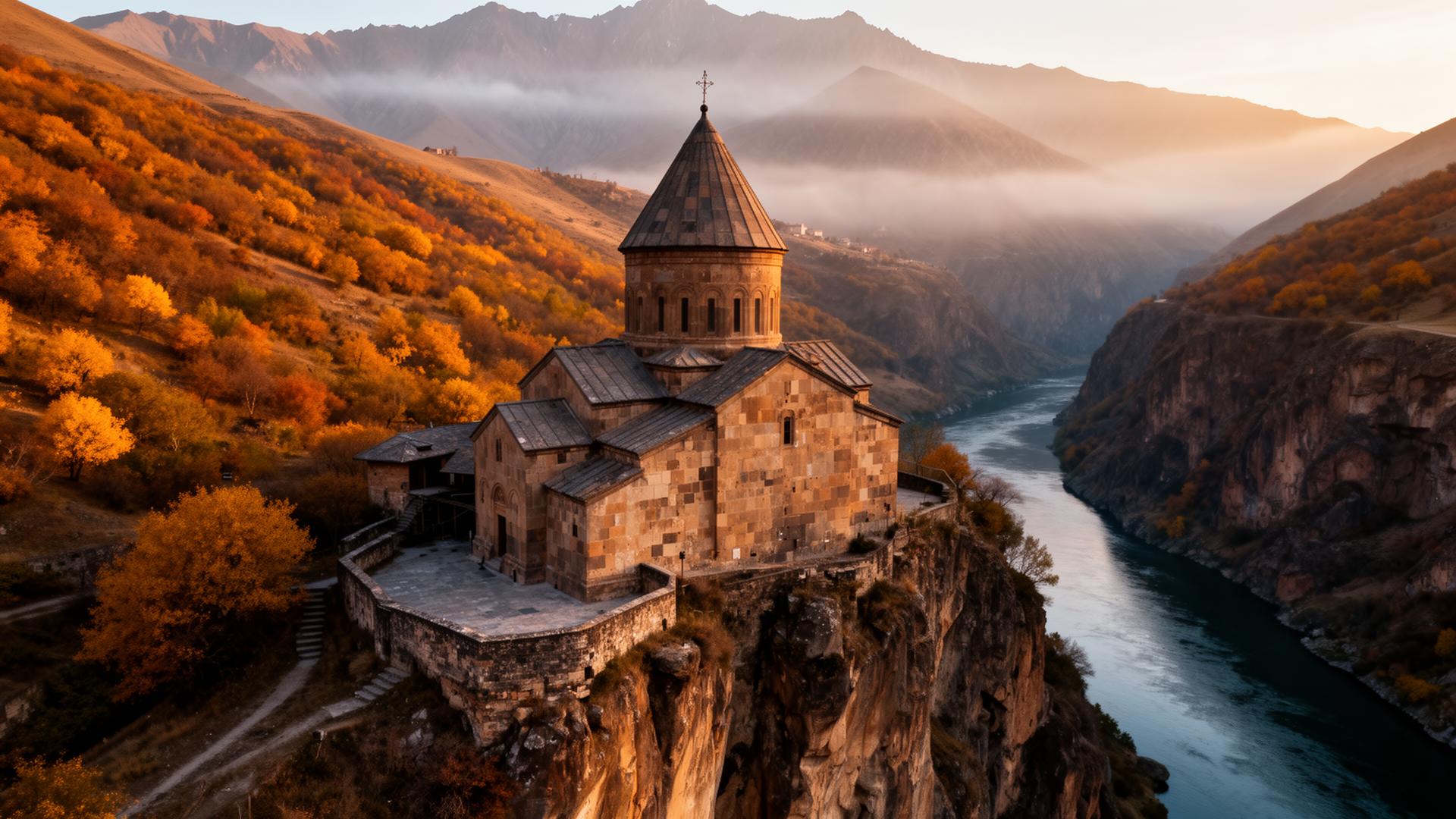
Armenia has more monasteries per square kilometre than almost any country on earth. Most are free to enter, many are UNESCO-listed, and nearly all sit in landscapes dramatic enough to justify the visit even without the architecture. The challenge is not finding monasteries but deciding which ones to prioritise, because a comprehensive tour could easily consume two weeks.
This guide organises the ten most striking Armenian monasteries into a logical driving sequence, starting from the Georgian border and working south. If you are picking up a cross-border rental car in Tbilisi, you can cover every site on this list in 5 to 7 days of comfortable driving.
Northern Armenia
1. Haghpat Monastery (10th Century)
UNESCO-listed since 1996, Haghpat sits on a ridge above the Debed Canyon at roughly 1,000 metres elevation. The main Church of the Holy Cross (Surp Nishan) was completed in 976 AD. The attached gavit (narthex), finished around 1210, is one of the finest examples of this uniquely Armenian architectural form: four massive columns supporting a vaulted ceiling with a central oculus that channels a cone of natural light onto the stone floor. The acoustics inside are extraordinary. A separate 13th-century bell tower at the edge of the complex offers panoramic views of the canyon.
Getting there: About 2.5 hours from the Georgian border via the Debed Canyon road. Steep switchbacks on the access road but paved throughout. Any car handles it.
2. Sanahin Monastery (10th Century)
Haghpat's sister monastery, 16 kilometres away on the opposite rim of the canyon, and part of the same UNESCO inscription. Sanahin is slightly older (founded mid-10th century) and arguably more complex in layout, with interconnected churches, chapels, a bell tower, and a scriptorium containing stone shelving carved directly into the walls. The monastery's Academy, built in 1063, was one of medieval Armenia's most important centres of learning. Dozens of intricately carved khachkars (cross-stones) are scattered across the grounds.
Getting there: From Haghpat, drive through Alaverdi and up the opposite side of the canyon. About 30 minutes between the two monasteries.
3. Odzun Church (6th Century)
One of the oldest standing churches in Armenia, this 6th-century basilica sits on a plateau above the Debed Canyon between Alaverdi and Vanadzor. The church itself is a large, well-proportioned basilica of pink stone, but the real curiosity is a pair of twin memorial stelae in the churchyard, carved with biblical scenes and dating to the 6th or 7th century. The hilltop position provides sweeping views down the valley.
Getting there: A short detour off the main Alaverdi-Vanadzor highway. Signed and easy to find.
Central Armenia
4. Geghard Monastery (4th-13th Century)
Partially carved into the rock face of a gorge in the Azat River valley, Geghard is one of Armenia's most atmospheric religious sites. The monastery was founded in the 4th century at the site of a sacred spring, but the surviving structures mostly date from the 12th and 13th centuries. Several chapels are cut directly into the cliff, with elaborate carvings of animals, geometric patterns, and religious scenes decorating the interior walls. The acoustics in the cave chapels produce a natural reverb that makes any sound hauntingly resonant. UNESCO-listed since 2000.
Getting there: About 40 kilometres southeast of Yerevan. Often combined with a visit to the Garni Temple (a Greco-Roman pagan temple, the only one in the Caucasus). The road is paved and straightforward.
5. Khor Virap Monastery
Famous less for its architecture than for its location: Khor Virap sits on a small hill in the Ararat plain, with Mount Ararat rising directly behind it. On a clear day, the snow-capped peak fills the entire background, creating one of the most photographed scenes in the Caucasus. The monastery marks the site where Gregory the Illuminator was imprisoned in a pit for 13 years before converting King Tiridates III to Christianity in 301 AD. You can descend into the pit via a narrow metal ladder.
Getting there: About 45 minutes south of Yerevan on the highway toward the Tatev route. Flat, fast road. Best visited on clear mornings when Ararat is visible.
6. Noravank Monastery (13th Century)
Tucked at the end of a narrow red-rock gorge that feels more like Utah than the Caucasus, Noravank is visually stunning before you even reach the monastery itself. The main church, Surp Astvatsatsin (1339), has an unusual two-storey design with a narrow external staircase leading to the upper chapel. The tympanum above the entrance features a remarkable carved relief of Christ flanked by Saints Peter and Paul. The rust-coloured cliffs surrounding the complex glow deep orange at sunset.
Getting there: About 2 hours south of Yerevan, off the main highway near Areni. The gorge road is paved and scenic. Often combined with wine tasting at Areni village cellars on the way in or out.
Southern Armenia
7. Tatev Monastery (9th Century)
Perched on a basalt cliff at the edge of the Vorotan Gorge, Tatev is one of the most dramatically sited monasteries in the world. The complex dates from the 9th century and once housed one of Armenia's most important medieval universities, with 600 students and faculty at its peak. The main church (Surp Poghos-Petros, 895 AD) is flanked by a smaller church, a 7th-century bell tower, and the Gavazan, an unusual octagonal pillar that sways during earthquakes. You can reach Tatev by road or via the Wings of Tatev aerial tramway, one of the longest reversible cable cars in the world (5.7 km).
Getting there: We have a full driving guide to Tatev covering the route from Yerevan via Khor Virap, Areni, and Noravank. The final approach is a mountain road with hairpin turns but paved throughout.
8. Zorats Karer (Carahunge)
Not a monastery but included here because it sits on the Tatev driving route and is too remarkable to skip. Armenia's "Stonehenge" is a field of over 200 standing stones, some with holes drilled through them that may have been used for astronomical observation. The site predates Armenia's Christian era by thousands of years and offers insight into the spiritual landscape that existed before the monasteries were built. A small museum at the entrance explains the archaeological findings.
Getting there: Near Sisian, about 30 minutes before reaching Tatev. Right beside the highway.
Western Armenia
9. Saghmosavank Monastery (13th Century)
Built on the edge of the Kasagh Gorge northwest of Yerevan, Saghmosavank ("Monastery of Psalms") is less visited than the more famous sites but equally impressive in setting. The monastery overlooks a deep basalt canyon with the Kasagh River far below. On clear days, Mount Ararat and Mount Aragats (Armenia's highest peak) are both visible. The 13th-century scriptorium attached to the main church is beautifully proportioned, with carved columns and a ribbed ceiling.
Getting there: About 45 minutes northwest of Yerevan, near the town of Ashtarak. Can be combined with nearby Hovhannavank Monastery (5 minutes away), which sits on the same gorge.
10. Amberd Fortress and Church
Technically a fortress with an attached church rather than a monastery, but the combination of 7th-century castle walls, an 11th-century church, and a setting at 2,300 metres on the slopes of Mount Aragats makes Amberd one of the most impressive historical sites in the country. The fortress sits at the junction of two rivers on a triangular promontory, with mountains rising on all sides. In early summer, the surrounding meadows are carpeted with wildflowers. Access requires a steep mountain road that is closed in winter.
Getting there: About 1.5 hours from Yerevan. The access road is paved for the first section, then becomes a rough track for the final 5 kilometres. A 4x4 is recommended, especially in spring when the road can be muddy.
Planning Your Monastery Road Trip
Suggested 5-Day Route
- Day 1: Cross the Georgian border, visit Haghpat and Sanahin, overnight in Vanadzor.
- Day 2: Drive south via Dilijan and Lake Sevan to Yerevan. Stop at Odzun on the way out of the canyon.
- Day 3: Day trip from Yerevan to Geghard and Garni (morning), Saghmosavank and Amberd (afternoon).
- Day 4: Drive south: Khor Virap, Noravank, Zorats Karer, Tatev. Overnight near Tatev or in Goris.
- Day 5: Return to Yerevan via a different route, or continue to Gyumri and back to Georgia.
What to Wear
Modest dress is expected at active monasteries. Shoulders and knees should be covered. Some monasteries provide wraps at the entrance, but do not count on it. Mountain sites (Amberd, Tatev) can be significantly colder than Yerevan, even in summer. Bring a light jacket.
Entry Fees
All monasteries and churches in Armenia are free to enter. Donations are welcome. The Wings of Tatev cable car is a separate paid attraction (around 7,000 AMD round-trip). Zorats Karer has a small museum fee of about 1,000 AMD.
Photography
Photography is permitted at all sites, including interiors. Tripods may attract attention from caretakers at busy sites but are generally tolerated. The best light for exterior photography is early morning or late afternoon, when the stone glows warm and shadows add depth to the carved surfaces.
Frequently Asked Questions
How many days do I need to see all ten monasteries?
Five days of driving covers all ten comfortably. With less time, the top five are Geghard, Tatev, Noravank, Haghpat, and Khor Virap, which can be done in 3 days.
Do I need a 4x4?
Only for Amberd Fortress (rough mountain access road). All other monasteries on this list are accessible by standard car. A sedan handles the routes fine. For maximum flexibility, a 4x4 from Yerevan lets you explore every site without restriction.
Are the monasteries crowded?
Geghard and Khor Virap attract the most visitors (especially on weekends). Haghpat, Sanahin, and Saghmosavank are rarely crowded. Tatev can be busy around the cable car but the monastery complex itself is usually quiet. Early morning visits avoid tour groups everywhere.
Can I visit monasteries on a day trip from Tbilisi?
Yes. Haghpat and Sanahin are feasible as a long day trip from Tbilisi (about 2.5 hours from the border). For monasteries further south, you need to overnight in Armenia. A cross-border rental is the most practical option.
What is the best season for visiting?
May through October. Spring (May-June) brings green landscapes and wildflowers. Autumn (September-October) adds golden foliage, especially in the Debed Canyon and around Dilijan. Summer (July-August) is hot in the lowlands but pleasant at mountain sites. Winter access is possible for most sites except Amberd, which is snowbound from November to April.