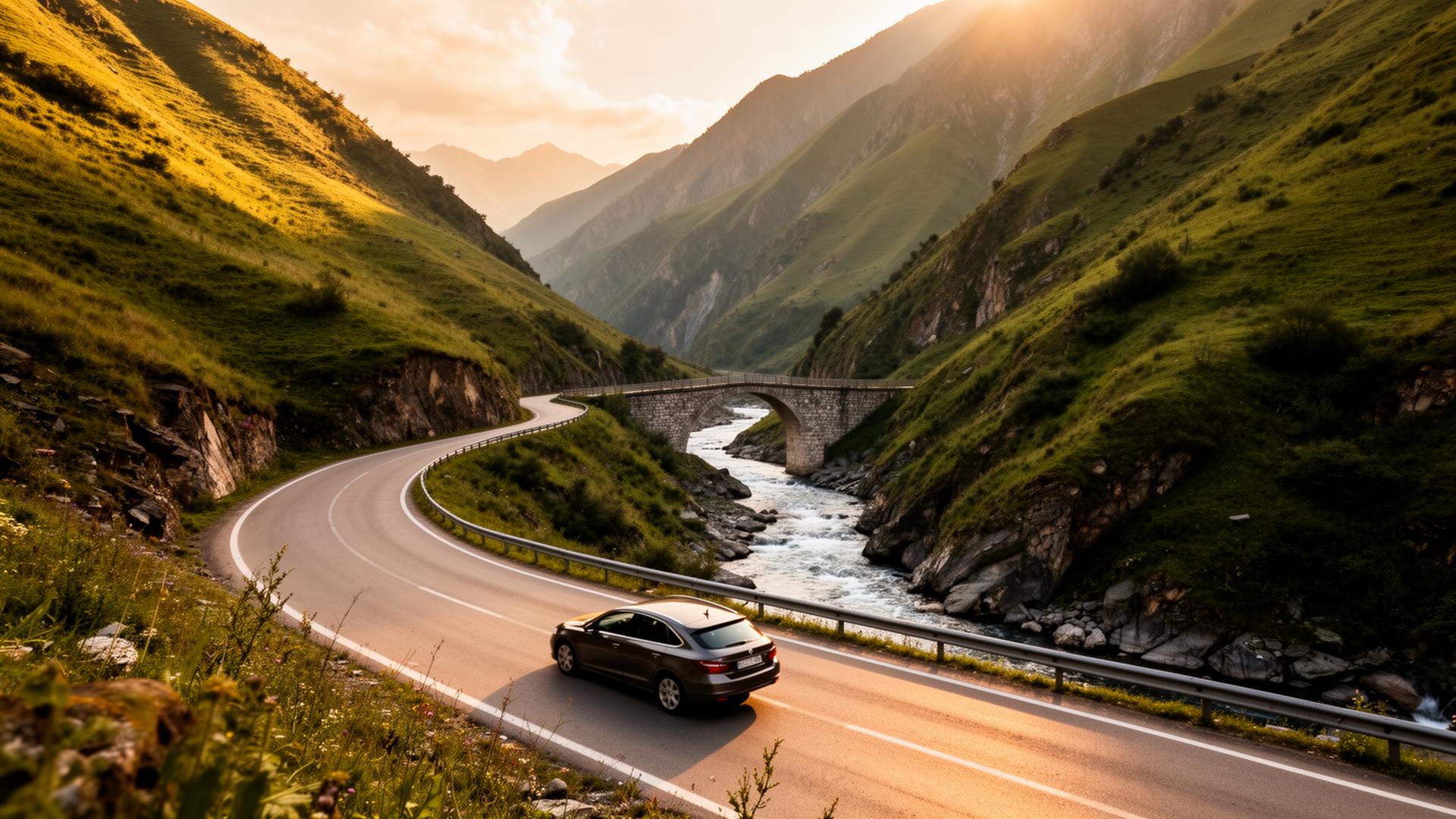
The border between Georgia and Armenia is one of the easiest international crossings in the Caucasus, and driving across it in a rental car opens up a completely different country within a few hours of leaving Tbilisi. The landscape changes fast: Georgian lowland farmland gives way to a steep river gorge, Soviet-era industrial towns, and ancient monasteries perched on canyon rims. If you have a cross-border rental, the whole process is straightforward, and you can be standing inside a 10th-century Armenian church before lunchtime.
This guide covers the border crossing itself, the documents you need, what the roads are like on the Armenian side, and the best places to stop in northern Armenia before continuing south toward Yerevan.
The Sadakhlo-Bagratashen Border Crossing
Location and Access
The main Georgia-Armenia land crossing sits at Sadakhlo on the Georgian side and Bagratashen on the Armenian side, about 100 kilometres south of Tbilisi. The drive from central Tbilisi takes roughly 1.5 hours on a decent two-lane highway that passes through Marneuli and the Kvemo Kartli lowlands. The road is flat, paved, and unremarkable until you reach the checkpoint.
What Happens at the Border
The crossing involves two separate stops. First, you clear Georgian exit immigration: the driver presents the car's registration documents and border permit (included with your FSTA cross-border rental), while passengers show passports. Georgian officers stamp you out. You then drive a short distance across a bridge over the Debed River to the Armenian checkpoint, where Armenian officers check passports, stamp entry visas (or verify visa-free status), and inspect the vehicle paperwork.
The entire process typically takes 20 to 40 minutes, though it can stretch longer on summer weekends or holidays. Weekday mornings tend to be the fastest. There is no fee for the border crossing itself.
Documents You Need
- Valid passport: Must be valid for at least six months beyond your planned stay. Many nationalities get visa-free entry to Armenia for up to 180 days. Check your eligibility before departing.
- Vehicle registration: The car's original registration document (or a certified copy provided by the rental company).
- Cross-border permit: A letter from the rental company authorising the vehicle to enter Armenia. FSTA includes this with every cross-border booking.
- Insurance: Armenian third-party motor insurance is mandatory. FSTA arranges this in advance, so you do not need to buy it at the border. If driving independently, you can purchase it at the crossing.
- Driving licence: Your home-country licence is accepted. An International Driving Permit is not required but can be useful as a backup.
Immediately After the Border: First 30 Minutes in Armenia
Once through the checkpoint, you are on a two-lane road heading south into the Debed River valley. Within the first few kilometres, several practical things are worth noting:
- Currency exchange: Armenia uses the dram (AMD). Small exchange booths and shops appear just past the border. Rates are reasonable. ATMs are available in Alaverdi (about 45 minutes further). Budget roughly 5,000 to 10,000 AMD for a meal and small purchases.
- Mobile data: Georgian SIM cards do not work in Armenia without roaming. If you have a Georgian SIM, activate a roaming package before crossing. Alternatively, pick up a local Armenian SIM in Alaverdi or Vanadzor for a few dollars.
- Fuel: Fill your tank before the border on the Georgian side (fuel stations are plentiful along the highway to Sadakhlo). Armenian fuel prices are slightly higher, and stations are less frequent in the canyon section. The next reliable fuel stop is in Alaverdi or Vanadzor.
Road Conditions on the Armenian Side
The highway south from Bagratashen follows the Debed River through a narrow gorge. The road is paved throughout but has sections with potholes, uneven surfaces, and occasional construction zones where upgrades are in progress. Speed is typically 40 to 60 km/h through the canyon due to curves and road quality.
Any car handles the main highway. A sedan is perfectly fine for the Tbilisi-to-Yerevan corridor. If you plan to explore side roads (to monasteries like Haghpat or Sanahin, for example), a car with decent ground clearance is more comfortable on the steep access roads, though not strictly necessary.
South of Vanadzor, the road improves significantly. The highway from Vanadzor to Lake Sevan and onward to Yerevan is well maintained and faster.
Best Stops in Northern Armenia
The stretch between the border and Vanadzor is packed with places worth pulling over for. Even if you are heading straight to Yerevan, building in a few hours of stops transforms the drive from a transit corridor into a proper road trip.
Akhtala Monastery
About 20 kilometres south of the border, a short detour leads to this 10th-century fortified monastery. The main draw is the interior: the walls are covered in remarkably well-preserved Byzantine-style frescoes, unusual for Armenian churches and more reminiscent of Georgian or Greek Orthodox traditions. Entry is free. Allow 30 minutes.
Alaverdi and the Copper Gorge
The town of Alaverdi sits at the bottom of the Debed Canyon, surrounded by steep forested hills and the rusting remains of a large Soviet copper smelter. The industrial landscape against the natural gorge creates a visual contrast you will not find elsewhere. A few basic restaurants in town serve home-cooked Armenian food at very low prices.
Haghpat and Sanahin Monasteries
These twin UNESCO World Heritage monasteries sit on opposite sides of the canyon, about 16 kilometres apart. Both date to the 10th century and represent the peak of medieval Armenian ecclesiastical architecture. We have a full driving guide to the Debed Canyon monasteries covering both in detail. Allow 2 to 3 hours to visit both properly.
Odzun Church
A 6th-century basilica just off the main highway between Alaverdi and Vanadzor. One of the oldest surviving churches in the region, with unusual twin memorial stelae in the churchyard and sweeping views of the valley below.
Vanadzor
Armenia's third-largest city makes a natural overnight stop if you want to break the drive. It has hotels, restaurants, ATMs, and a fuel station. From here, the highway south to Dilijan and Lake Sevan is fast and scenic.
Should You Do a Day Trip or Stay Longer?
A day trip from Tbilisi to northern Armenia is technically possible. You can cross the border in the morning, visit one or two monasteries, eat lunch in Alaverdi, and return to Tbilisi by evening. But it makes for a very long day with 4 to 5 hours of driving round-trip, leaving limited time at each stop.
The better approach with a rental car is to make northern Armenia the first leg of a longer loop. Cross the border, explore the canyon, overnight in Vanadzor, then continue south through Dilijan, Lake Sevan, and Yerevan. From Yerevan, you can drive south to Tatev, west to Gyumri, or return to Tbilisi via the same border crossing.
A comfortable circuit covering northern and central Armenia takes 4 to 6 days. The FSTA cross-border rental includes unlimited mileage, so the longer you explore, the better value the car becomes.
Driving Tips for Armenia
- Drive on the right. Same as Georgia.
- Speed limits: 60 km/h in towns, 90 km/h on open roads, 110 km/h on highways (where posted). Police speed checks exist, especially near Vanadzor and on the approach to Yerevan.
- Headlights: Daytime running lights are mandatory year-round in Armenia.
- Seatbelts: Required for all occupants.
- Alcohol limit: 0.0 BAC. Zero tolerance.
- Road signs: Major signs are in Armenian script and English. In rural areas, some signs are Armenian only, so a GPS or offline map is essential.
- Tolls: There are no toll roads in Armenia.
Returning to Georgia
The return crossing at Bagratashen-Sadakhlo follows the same process in reverse. Georgian entry immigration is typically even faster than the Armenian side. One important note: if your rental car's cross-border permit specifies return dates, make sure you cross back within that window. FSTA permits are flexible and cover the full rental period.
If you are dropping the car in Yerevan rather than returning to Tbilisi, FSTA offers one-way cross-border rentals with drop-off at Yerevan hotels or Zvartnots Airport.
Frequently Asked Questions
Can I take any rental car from Georgia into Armenia?
No. Most Georgian rental companies do not permit cross-border travel. You need a rental with an explicit cross-border authorization and the correct insurance. FSTA's cross-border rentals include all necessary documentation.
How long does the border crossing take?
Typically 20 to 40 minutes for the full process (Georgian exit plus Armenian entry). Summer weekends can be slower. Weekday mornings are fastest.
Do I need an International Driving Permit for Armenia?
No. Your home-country driving licence is accepted in Armenia. An IDP is not required but can serve as a useful backup document.
Is the drive from Tbilisi to Yerevan doable in a single day?
Yes. The total distance is about 280 kilometres, taking 5 to 6 hours including the border crossing. But adding stops in northern Armenia turns it into a much more rewarding journey spread over 2 or more days.
What if I only have one day?
Cross the border early, drive directly to Haghpat or Sanahin, have lunch in Alaverdi, and return to Tbilisi by evening. It is a full day (10 to 12 hours total) but feasible with your own car.
Can I pick up a car in Tbilisi and drop it in Yerevan?
Yes. FSTA offers one-way cross-border rentals from Tbilisi to Yerevan (and vice versa) with drop-off at Yerevan city hotels or the airport.