Armenia is the first country in the world to have adopted Christianity as its state religion, a nation whose alphabet was invented by a single monk in 405 AD, and the homeland of a people who have occupied the same territory for over 3,000 years. It is also a country defined by catastrophic loss. The events of 1915 to 1923, in which an estimated 1.5 million Armenians were killed by Ottoman authorities, shaped the modern nation more profoundly than any other single event. You cannot understand Armenia without understanding this history.
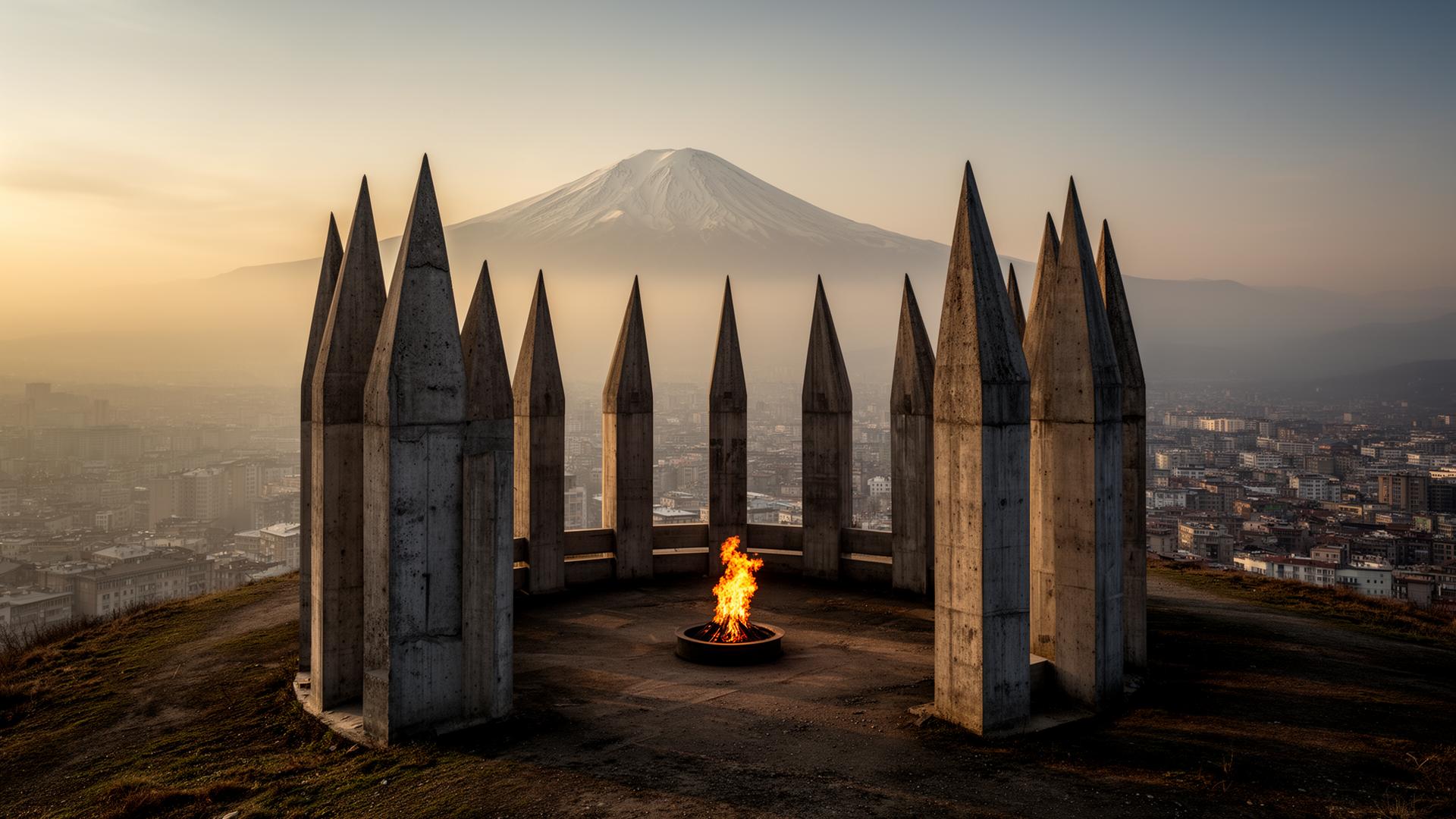
Tsitsernakaberd, the Armenian Genocide Memorial Complex, stands on a hill in western Yerevan overlooking the city and, on clear days, Mount Ararat across the Turkish border. It is the most important site in the country for visitors who want to grasp the weight of what Armenia carries. This guide covers the memorial, the adjacent museum, the historical context, and the practical details for visiting.
The Historical Context
Armenians had lived in the eastern provinces of the Ottoman Empire for centuries. By the late 19th century, rising nationalism within the empire and a series of massacres under Sultan Abdul Hamid II (the Hamidian massacres of 1894 to 1896) had already targeted Armenian communities. The situation escalated dramatically during World War I.
On 24 April 1915, Ottoman authorities arrested and deported hundreds of Armenian intellectuals, community leaders, writers, and clergy from Constantinople (modern Istanbul). This date marks the beginning of a systematic campaign of deportation, forced marches into the Syrian desert, mass executions, and starvation that continued until 1923. The term "genocide" was coined in 1944 by Raphael Lemkin, a Polish lawyer, partly in reference to the Armenian experience.
The consequences extended far beyond the death toll. The Armenian population of Western Armenia (eastern Turkey) was effectively erased. Centuries of cultural infrastructure, churches, schools, and communities were destroyed. The survivors scattered across the globe, creating a diaspora that today outnumbers the population of the Republic of Armenia itself (roughly 3 million in Armenia, an estimated 7 million in the diaspora).
International recognition of the genocide remains incomplete. As of 2026, over 30 countries formally recognise it, including the United States (since 2019), France, Germany, and Russia. Turkey disputes the characterisation. This ongoing denial is itself a source of deep national pain for Armenians and adds a political dimension to every aspect of remembrance.
The Memorial: Architecture as Mourning
Tsitsernakaberd was built in 1967 after mass public demonstrations in Yerevan demanding official Soviet recognition of the genocide, an extraordinary act of defiance within the USSR. The complex was designed by architects Arthur Tarkhanyan and Sashur Kalashyan and occupies a prominent hilltop position visible from much of the city.
The memorial has three main elements:
- The twelve basalt slabs: Arranged in a circle and leaning inward, these tall pointed stones represent the twelve lost provinces of Western Armenia. They create a sheltered interior space that feels both protective and oppressive: a physical metaphor for a nation closing around its wound.
- The eternal flame: Burns at the centre of the circle, at the base of a sunken platform. Visitors descend to place flowers around it. The flame has not been extinguished since its lighting.
- The 44-metre stele: A tall, narrow spire that rises nearby, split into two parts. One section represents Western Armenia (lost), the other Eastern Armenia (survived). The crack between them is the genocide itself.
The effect of the architecture is powerful without being theatrical. There is no music, no narration, no guided path. You walk, you observe, you descend to the flame, and you leave. The simplicity is the point.
The Genocide Museum-Institute
Adjacent to the memorial, the museum opened in 1995 (on the 80th anniversary) and was significantly expanded in 2015. It is built into the hillside, with exhibitions descending underground in a deliberate architectural choice: you go deeper as the story gets darker.
The museum presents the genocide through photographs, documents, survivor testimonies, newspaper clippings from the period, and multimedia installations. The chronological layout traces the events from the late Ottoman period through the massacres, deportations, desert death marches, and ultimately the international response (or lack of it).
Some material is graphic. Photographs of victims, mass graves, and emaciated deportees are displayed without sanitisation. This is intentional: the museum exists partly as evidence against denial. If you are visiting with children, be prepared for difficult conversations.
Allow 1.5 to 2 hours for the museum. Audio guides are available in multiple languages.
April 24: Remembrance Day
Every year on 24 April, hundreds of thousands of people walk to Tsitsernakaberd in a peaceful procession to lay flowers at the eternal flame. The march begins in central Yerevan and moves uphill to the memorial. Schools close, businesses shut, and the city takes on a quiet, reflective character. By evening, the flowers around the flame are stacked metres high.
If you are in Yerevan on this date, you are welcome to participate. The march is peaceful, open to everyone, and requires no special arrangements. Wear neutral clothing, carry flowers if you wish (tulips and forget-me-nots are traditional), and maintain a respectful demeanour. Photography is acceptable but be mindful of people in mourning.
Practical note: April 24 is a national holiday. Most attractions, restaurants, and shops in Yerevan close for the day, including the Genocide Museum itself. Plan accordingly.
The purple forget-me-not is the international symbol of Armenian Genocide remembrance, chosen for the centenary in 2015. You will see it on pins, stickers, and banners throughout Yerevan in the weeks surrounding April 24.
Why This Matters for Visitors
Understanding the genocide is not optional context for visiting Armenia. It is foundational. The memorial at Tsitsernakaberd appears in conversations, in school curricula, in the view from restaurant terraces. The diaspora communities you may have encountered at home, whether in Los Angeles, Marseille, Beirut, or Buenos Aires, exist because of what happened in 1915.
When you visit Armenian monasteries, you are seeing what survived. When you hear Armenians speak with intensity about their alphabet, their church, their music, their food, you are hearing a people who came close to losing everything and are acutely aware of what remains. The genocide shapes Armenian hospitality, Armenian politics, and the relationship between Armenia and its neighbours.
Visiting Tsitsernakaberd is an act of respect. It costs nothing, takes two hours, and will reframe every other experience you have in the country.
Visiting Logistics
- Location: Tsitsernakaberd Hill, western Yerevan. About 3 km from the city centre.
- Getting there: Drive or take a taxi (10 minutes from Republic Square). Free parking available at the top of the hill. If you have a rental car, the memorial is an easy stop before or after exploring the city.
- Memorial hours: The outdoor memorial is accessible 24 hours. The hilltop park is a popular walking area for locals.
- Museum hours: Tuesday to Sunday, 11:00 to 16:00. Closed Mondays and on April 24. Free admission.
- Duration: 30 minutes for the memorial alone. 1.5 to 2 hours including the museum.
- Dress code: No formal requirements, but modest, neutral clothing is appropriate given the setting.
- Combining with other sites: The memorial sits near the Hrazdan Gorge. You can combine it with a visit to the Cascade complex (20 minutes' walk) or drive to GUM Market (10 minutes). For a full Yerevan itinerary, see our city guide.
Further Reading and Context
For visitors who want deeper understanding before or after their visit:
- The museum's own research institute publishes academic papers and survivor testimonies, many available in English on their website.
- For broader context on Armenian culture and why it endures, see our Armenia heritage guide.
- To understand how genocide memory connects to modern Armenian identity, visit the Sergei Parajanov Museum in Yerevan, which celebrates one of the 20th century's most important filmmakers and his exploration of Armenian themes.
- For a driving itinerary that connects Yerevan's cultural sites with monasteries and landscapes, see our monasteries road trip and Caucasus planning guide.
Frequently Asked Questions
Is the memorial appropriate for children?
The outdoor memorial is suitable for all ages. The museum contains graphic photographs that may be distressing for younger children. Use your judgement based on your child's age and temperament.
Do I need to book the museum in advance?
No. The museum is free and does not require advance booking. Audio guides are available at the entrance.
Can I visit on April 24?
The outdoor memorial is open and the public march takes place throughout the day. However, the museum is closed on April 24. Roads around the hill may be restricted to vehicle traffic during the march.
Is there parking at Tsitsernakaberd?
Yes. A free car park is located at the top of the hill, accessible via a paved road from Tsitsernakaberd Highway. A rental car makes the visit straightforward.
How does this fit into a wider Armenia itinerary?
Visit on your first or second day in Yerevan, before heading to the monasteries and landscapes. Understanding the genocide provides essential context for everything else you will see. Combine with our Yerevan guide, then drive to Lake Sevan, the Debed Canyon, or Tatev.