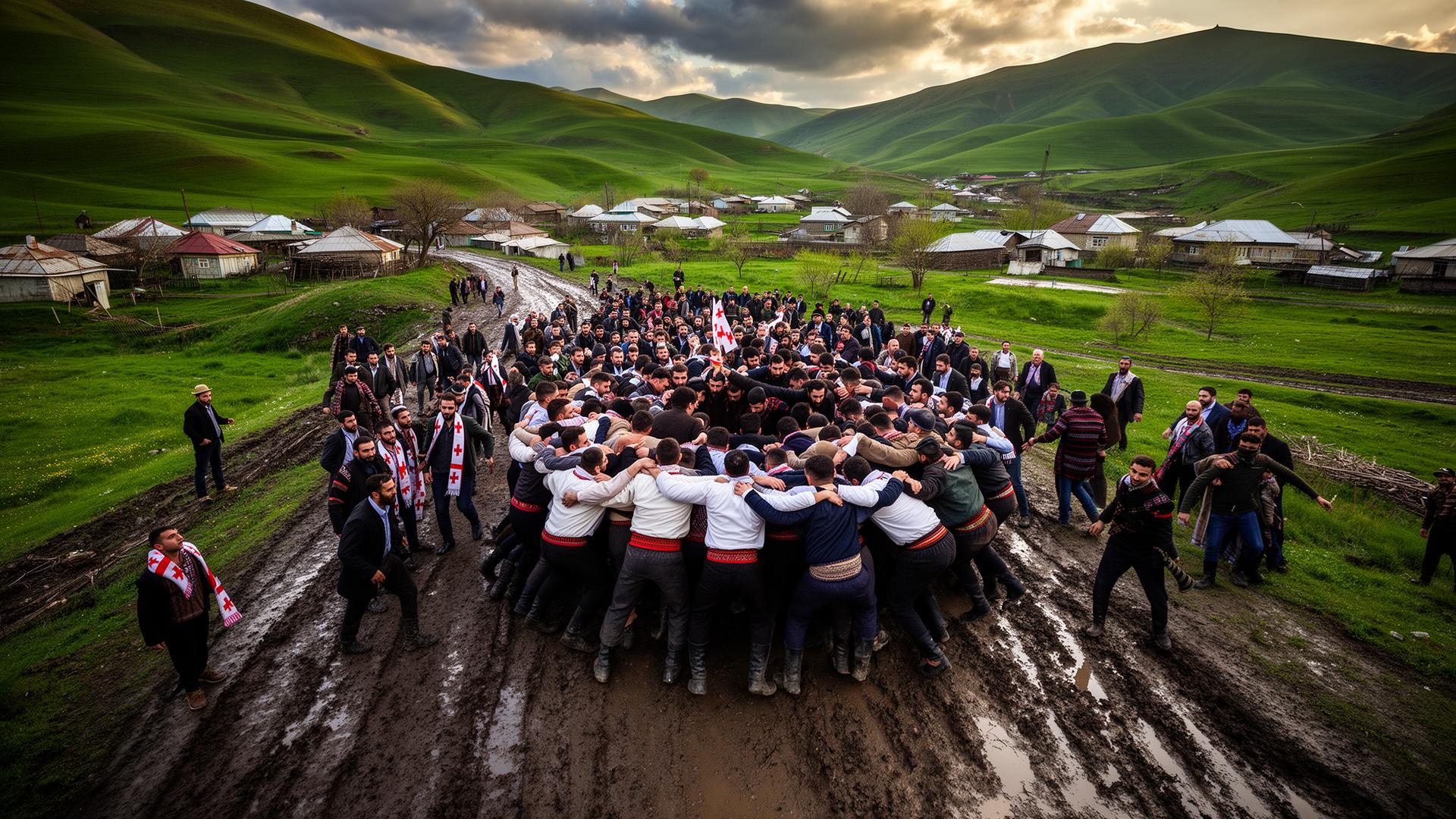
Somewhere in western Georgia, on a muddy village road lined with wooden houses and barking dogs, several hundred men are locked together in a single heaving mass. Nobody is running. Nobody is throwing anything. The entire scrum inches forward like a geological event, flattening fences and churning the earth into soup. Buried inside is a 16-kilogram leather ball stuffed with sand and soaked in wine. This is Lelo Burti, and it is the most extraordinary sporting event you have never heard of.
What Lelo Burti Actually Is
Lelo Burti (literally "field ball") is a traditional Georgian contact sport with roots stretching back more than 800 years. The 12th-century epic poem The Knight in the Panther's Skin by Shota Rustaveli references the game. Some historians trace it to Gurian resistance against Ottoman forces: the first matches may have been victory re-enactments after a small band of local fighters defeated an Ottoman battalion.
During the Soviet era, authorities standardised the rules and the sport was played regularly across the country. When the USSR collapsed, rugby union gradually replaced lelo as the organized team sport of choice. Today, the game survives in only one place: the village of Shukhuti in Guria, western Georgia, played once a year on Orthodox Easter Sunday.
The Rules (Such As They Are)
Two teams from Upper Shukhuti (Zemo) and Lower Shukhuti (Kvemo) face off on the village's main road. The objective: carry the ball to the opposing team's stream, roughly 500 metres in either direction. There is no passing, no throwing, no kicking. Players push, pull, and wrestle the ball forward inside a dense human knot. Most participants never touch the ball at all. Their job is to press against the mass to shift momentum.
A new ball is made for each match. The outer shell is soft black leather, the interior packed with sawdust, dirt, and sand, then ceremoniously sewn shut and blessed by the village priest, Father Saba, at St. George's Church. White lettering marks the year. The ball weighs approximately 16 kilograms.
There are no referees. Players rotate in and out of the scrum freely, breaking away for water or a breather before diving back in. When someone falls and cannot get up, nearby players raise their hands to signal for help, and the crowd pulls the person out. The match can last anywhere from 90 minutes to several hours.
What Happens Before the Game
The festival atmosphere builds from late morning. By noon, a small Easter market opens in a park next to the church, selling Gurian food, honey, handicrafts, and local wine. Wrestling matches (khridoli) and martial arts demonstrations take place on a clearing near the park from around 11am. A stage hosts folk music and dance performances through the afternoon.
Inside the church, the new ball rests on an altar at the back. Visitors file in throughout the afternoon to see it and take photographs. Statues depicting lelo players stand alongside. The church cemetery behind holds previous years' balls, each encased in a transparent cube on a gravestone, like museum exhibits.
The main road through the village closes from 10am. Parking is available outside the closure zone. Arrive by noon at the latest to secure a spot and soak in the pre-game energy.
The Match Itself
At precisely 5pm, Father Saba carries the ball from the church into the middle of the road where several hundred players have assembled. A shotgun fires. The ball drops. The scrum forms instantly.
For the next two hours (give or take), the knotted mass of bodies crawls down streets, through backyards, over fences, and across open fields. The ball stays low, locked in someone's arms, invisible to spectators. You hear shouting as players coordinate strategy over the noise. On the sidelines, fans cheer when the scrum moves their way and throw their hands up when it drifts back.
Spectators stake out vantage points on rooftops, fence posts, and parked tractors. Most of the crowd follows on foot, intermingled with the players. Drones buzz overhead. Keep your wits about you: when the scrum accelerates, you need to move or risk being swallowed by it.
Players emerge from the pack red-faced and gasping, soaked in sweat and mud. Bystanders hand them water bottles. Some light a cigarette, catch their breath for thirty seconds, and plunge back in.
After the Final Whistle
When one team wrestles the ball into the opposing stream, the winning side erupts. The losers melt into the crowd. The victors carry the ball in a procession through the village, stopping at houses along the route so families can see it and take photos. At one stop, a bottle of red wine appears and is syphoned into small glasses using a plastic tube. The ball is baptised with wine. Toasts are raised.
The procession ends at the village cemetery on a hill. A feast is waiting. After speeches and a long gaumarjos, a player settles the ball on the grave of someone who died during the previous year. In centuries past, the winning team believed their victory guaranteed a better harvest. Today, the ritual honours the dead. The mood shifts from celebration to reverence, and most spectators quietly leave.
Getting to Shukhuti
Shukhuti is in the Lanchkhuti municipality of Guria, western Georgia. Distances from major cities:
- From Kutaisi: 70 km, about one hour by car
- From Batumi: 90 km, about 90 minutes by car
- From Tbilisi: 300 km, about 4.5 hours by car
A rental car is by far the best option. The game finishes after dark and there are no hotels in Shukhuti, so you need your own transport to leave. We deliver free to Batumi, Kutaisi, and Tbilisi with no deposit and unlimited mileage.
If you do not have a car, marshrutka vans from Tbilisi and Kutaisi bound for Batumi pass through Lanchkhuti on the highway. Drivers know the festival and will drop you nearby. Easter Sunday is a public holiday, so expect a reduced schedule. Returning is trickier because the game ends late.
Parking
The main road closes at 10am and does not reopen until the match ends. Park on the road shoulder before the Optima petrol station, or on a backstreet beyond the roadblock if approaching from the coast. Street parking is informal and free.
Where to Stay
The nearest accommodation is in Ozurgeti, Guria's main town (about an hour from Shukhuti). Samtredia is another option at around 40 minutes. Both towns have guesthouses and small hotels. Book well in advance because Easter weekend fills up fast in this region.
Practical Tips
- Arrive by noon. The road closes at 10am and the pre-game entertainment starts before lunch.
- Bring cash. Some market vendors have card machines, many do not.
- Wear shoes you can sacrifice. The playing field turns to mud. Anything white is a bad idea.
- Protect your phone and camera. The scrum moves unpredictably. Keep equipment close to your body.
- Stay alert during the match. When the mass of players shifts direction, move with it or get out of the way. Bystanders are rarely hurt, but it is not impossible.
- Visit the church before kickoff. See the ball on its altar, meet Father Saba if he is free, and walk through the cemetery to find previous years' balls on the graves.
- Remember it is Easter. Most cafes and restaurants in the area are closed. The market at the festival sells food and drinks, but pack snacks and water to be safe.
Combining Lelo Burti with a Guria Road Trip
Easter weekend is the perfect excuse to explore Guria, one of Georgia's most underrated regions. Spend the Saturday exploring Ozurgeti's market, the Gurian tea plantations, and the traditional wooden oda houses scattered through the hills. Attend Lelo Burti on Sunday. On Monday (Bright Monday), visit a village cemetery to witness the graveside feast tradition that is central to Georgian Easter.
From Guria, you can continue south to Batumi and the Black Sea coast, or loop back through Kutaisi to visit the Tskaltubo sanatoriums. A comfortable circuit from Tbilisi takes four to five days.
2026 Date
Lelo Burti always falls on Orthodox Easter Sunday. In 2026, the date is Sunday, April 12. Future dates: May 2, 2027 and April 16, 2028.
Frequently Asked Questions
Is Lelo Burti dangerous for spectators?
The risk is low but not zero. The scrum can shift direction suddenly. Stay aware of the crowd's movement and give the players space. Most injuries happen to participants, not onlookers.
How long does the Lelo Burti match last?
Typically 90 minutes to three hours, depending on conditions and the strength of the teams. The game starts at 5pm and usually finishes after dark.
Can anyone play in Lelo Burti?
In theory, any man from the two villages can join. In practice, the teams include hundreds of players who rotate in and out freely. Tourists do not participate.
Do I need a car to get to Shukhuti?
Strongly recommended. The game finishes late, there are no hotels in the village, and public transport runs on reduced Easter schedules. We offer free delivery to Batumi, Kutaisi, and Tbilisi.
What else is there to do in Guria?
Tea plantations, traditional wooden houses, Ozurgeti's bazaar, Black Sea beaches, and the wider Easter cemetery tradition on Monday. See our complete Guria guide for details.