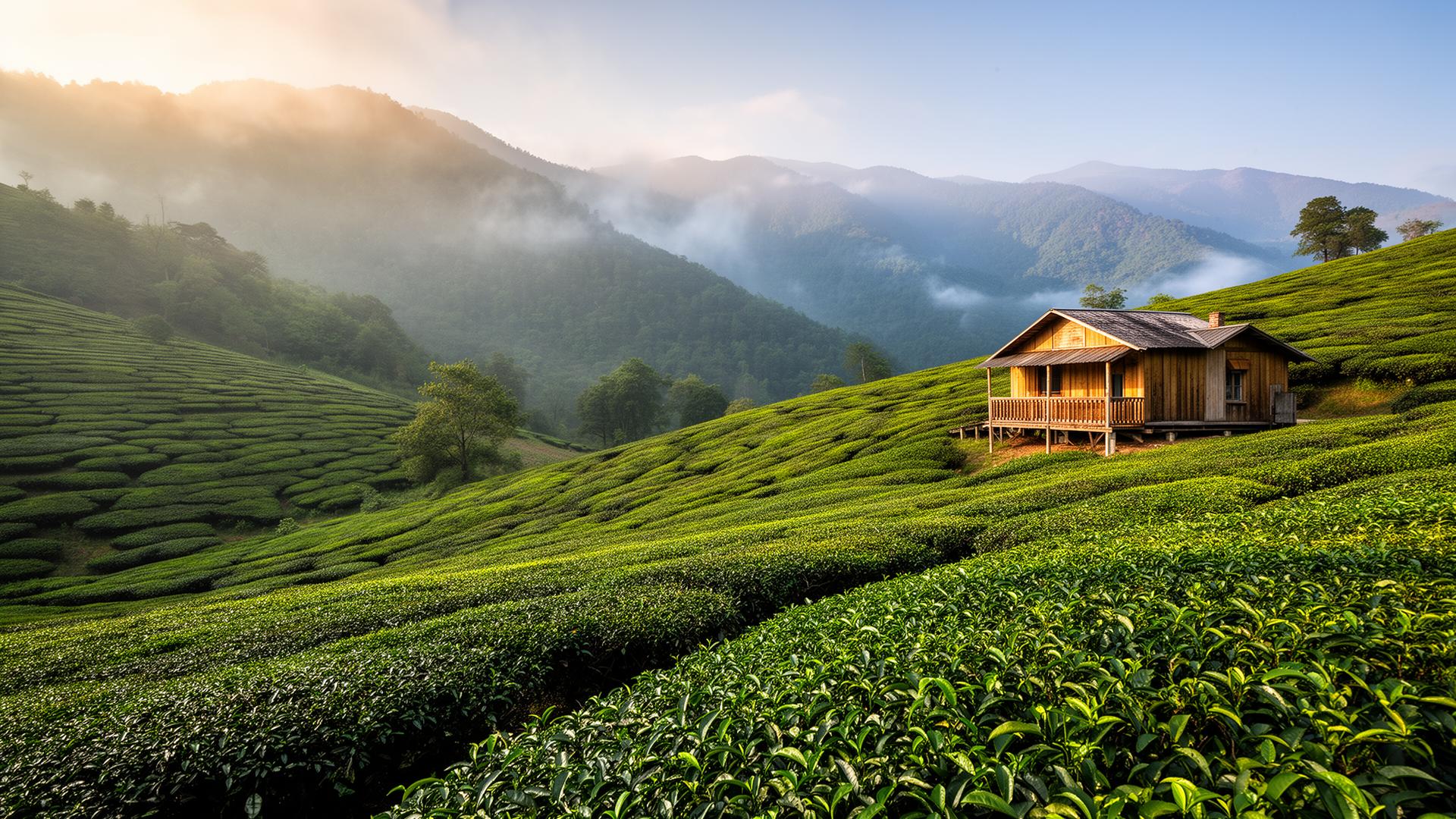
If you ask most travelers about western Georgia, they will mention Batumi and maybe Kutaisi. Almost nobody brings up Guria. That is a shame, because this tiny region between the two cities holds some of the most distinctive experiences in the country: artisan tea farms reviving a Soviet-era industry, misty mountain resorts where the sunset paints itself across a sea of clouds, a food culture built on its own rules, and enough abandoned Soviet architecture to keep a photographer busy for days.
Guria is compact enough to explore thoroughly in three to four days. The roads are well-maintained, distances are short, and the region rewards slow, curious driving. Here is our complete guide.
Why Guria Stands Apart
Georgia has 12 regions, and Guria is the smallest by area. But size tells you nothing about character. Three things make this corner of the country genuinely different:
First, the tea heritage. Georgia was once the fifth-largest tea producer on Earth, and Guria was the beating heart of that industry. When the Soviet Union collapsed, the factories shuttered and the fields went wild. Now a handful of families are bringing artisan tea back to life, growing heritage bushes using organic methods and offering tastings that rival anything in Kakheti's wine country.
Second, the mountain resorts. Gomismta and Bakhmaro sit above 2,000 metres and are famous for their wooden A-frame cottages, alpine meadows, and a meteorological quirk that fills the valleys with thick mist at dusk. On clear evenings, the sun sets over what looks like an ocean of cotton. These mountains are now accessible on newly sealed roads, no 4x4 required.
Third, the Soviet legacy. Guria's villages grew wealthy from tea and citrus during the mid-20th century. That prosperity funded ornate public buildings, theatres, and mosaic-covered bus stops that are now slowly crumbling. For anyone interested in Soviet-era architecture and urban exploration, this region is a goldmine.
Suggested 3 to 4 Day Itinerary
Day 1: Arrive in Ozurgeti and Explore the Tea Route
Ozurgeti is Guria's main city and your base for the trip. It is about two hours from Batumi or Kutaisi, and roughly five to six hours from Tbilisi on the main highway.
Start with the tea plantations around Anaseuli, on Ozurgeti's southwestern edge. This area was the centre of Georgia's industrial tea production, and you can still see the remnants: overgrown fields, rusting factory equipment, and the grand but abandoned Tea and Subtropical Crops Institute where groundbreaking cold-resistant tea varieties were developed.
From there, follow the Western Tea Route to one of the small-scale producers who are reviving artisan Georgian tea. Several family farms offer two-hour experiences where you pick leaves, watch them roasted and dried, and taste the results on a wooden verandah overlooking the fields. Green, black, and white varieties are all produced here, and the flavour profiles are surprisingly complex.
End the day with a stroll through Ozurgeti's compact centre. The Dramatic Theatre, one of the largest in Georgia, anchors the main street. The Platanus Garden, laid out by a Scottish landscaper in the 19th century for the local prince, is shaded by century-old plane trees and sits next to the Assumption Cathedral.
Overnight in Ozurgeti or at a nearby farmstay on the Tea Route.
Day 2: Soviet Architecture, Mosaics, and Gurian Wine
Guria has one of the highest concentrations of Soviet-era mosaics and public art in Georgia. A self-drive circuit through the surrounding villages reveals extraordinary finds:
- The Gurianta bus stop, with vivid mosaic panels depicting tea pickers and hazelnut farmers under a wooden peaked shelter
- The Naruja kindergarten, where an entire wall is covered in a remarkably preserved mosaic of fairytale characters and a smiling sun
- The Shroma village hall, a grand Stalinist building with elaborate plasterwork, glass mosaics, and a WWII memorial with an actual tank outside
- The Natanebi administration building, with its portico of communist insignia on ultramarine domes, now partly converted into a wrestling gym
In the afternoon, drive to Shemokmedi Monastery, a 12th-century complex that was once the wealthiest monastery in Georgia. The cemetery on the approach path has remarkable headstones from the 1930s and 40s, and the church interior holds faded but atmospheric frescoes.
Nearby, stop for a Gurian wine tasting. The local Chkhaveri grape produces a light, berry-noted red wine made in clay qvevri vessels. The humid climate means vintners here use a unique technique called olikhnari, growing grapes on tall props raised above the ground. Some farms even grow vines on actual tree trunks.
Day 3: Gomismta or Bakhmaro (Mountain Day)
Pick one of Guria's twin mountain resorts, or do both if you start early.
Gomismta is closer to Ozurgeti (about 45 minutes on a newly sealed road). The drive climbs through hairpin bends to 2,755 metres. At the top, shepherds graze their flocks among scattered wooden cabins. If conditions cooperate, the dusk mist fills the valleys below and the sunset is extraordinary. Even in a total whiteout, the atmosphere is otherworldly.
Bakhmaro is further (about two hours) but has more infrastructure, including a wooden church, better cabin rentals, and a designated sunset viewpoint reached by a steep one-hour hike. The village itself sits at 1,950 metres in a valley surrounded by pine forest. If you time your visit for August 19, the annual Bakhmaro Horse Cup brings traditional riding competitions and festival energy.
Both mountain roads are sealed and manageable in any car. They close in winter and typically reopen in late May or early June.
Day 4 (Optional): Black Sea Coast and Chokhatauri
Guria has a short stretch of Black Sea coastline that is far quieter and less developed than Batumi. The black sand beaches around Shekvetili and Ureki are popular with Georgian families but rarely visited by international tourists. The magnetic black sand here is believed to have therapeutic properties.
If it is a Sunday, detour northeast to Chokhatauri for the weekly market. The town sits at the foot of the mountains and the Sunday bazaar draws villagers from across the region. It is a great place to buy local hazelnuts, honey, and handwoven tea-picking baskets.
What to Eat in Guria
Guria has its own distinct food traditions that differ from the rest of Georgia:
- Gurian khachapuri (Guruli ghvezeli): A crescent-shaped cheese bread stuffed with a hard-boiled egg inside. Unique to this region and traditionally served at Easter, but available year-round.
- Gurian chicken: A local stew preparation that uses walnuts and aromatic herbs in ways you will not find in Tbilisi restaurants.
- Hazelnuts: Guria is Georgia's hazelnut capital. They appear in sauces, desserts, and are sold raw by the kilo at every market.
- First-flush tea: The spring harvest (around mid-April) produces naturally sweet, smooth tea. Ask at any farm on the Tea Route.
- Chkhaveri wine: The local red made from grapes grown on elevated props. Give it time to breathe.
Driving Conditions
Guria has excellent road infrastructure for its size. The main highway connecting Batumi and Kutaisi passes through the region, and all secondary roads to the places mentioned in this guide are sealed.
The mountain roads to Gomismta and Bakhmaro were resurfaced in 2024 and are now smooth asphalt with guardrails. They are steep with tight switchbacks but perfectly manageable in a sedan. No 4x4 needed for any part of this itinerary.
Public transport within Guria is very limited. Having your own car transforms what you can see and do. The region is compact, with most drives under an hour.
When to Visit
- Late April to May: Tea harvest season. Warm weather, green landscapes, wildflowers. Mountain roads may still be closed.
- June to September: Mountain resorts are open. Best for Gomismta and Bakhmaro sunsets. Coast gets busy in July and August.
- October: Quieter, comfortable temperatures, autumn colours starting. Great for tea farms and Soviet architecture.
- Winter: Mountain roads close. Ozurgeti and the coast remain accessible but wet and chilly.
For a broader overview, check our seasonal guide to Georgia.
Renting a Car for Guria
We deliver free to Batumi, Batumi Airport, Kutaisi, and Kutaisi Airport. No deposit, unlimited mileage, and prices from €30/day.
Guria pairs naturally with a Batumi beach stay, a drive through Samtskhe-Javakheti via the Goderdzi Pass (4x4 recommended), or a loop through Racha from Kutaisi. For more off-the-beaten-path ideas, see our hidden gems guide.