Georgia does not do Easter the way you think it does. There are no chocolate bunnies, no pastel decorations, no egg hunts on the lawn. What Georgia has instead is something older and stranger: families huddled around a pot of boiling madder root, midnight processions lit only by candles passed hand to hand, and entire villages sitting down to lunch among the headstones of their ancestors.
Orthodox Easter (Aghdgoma) is the most significant religious event in the Georgian calendar, but it plays out mostly behind closed doors. For visitors, that can make it feel invisible. This guide is designed to pull back the curtain so you can appreciate what is happening around you and, if you choose, participate.
2026 Calendar: Four Days Off, One Long Weekend
Orthodox Easter follows the Julian calendar, which means dates shift each year and almost never align with Catholic Easter. In 2026, the key dates are:
- Sunday, April 5: Bzoba (Palm Sunday equivalent)
- Thursday, April 9: Chiakokonoba (Maundy Thursday)
- Friday, April 10: Tsiteli Paraskevi (Red Friday). National holiday.
- Saturday, April 11: Holy Saturday. National holiday.
- Sunday, April 12: Easter Sunday. National holiday.
- Monday, April 13: Bright Monday. National holiday.
Future dates: May 2, 2027 and April 16, 2028.
The Colour Red and Why It Matters
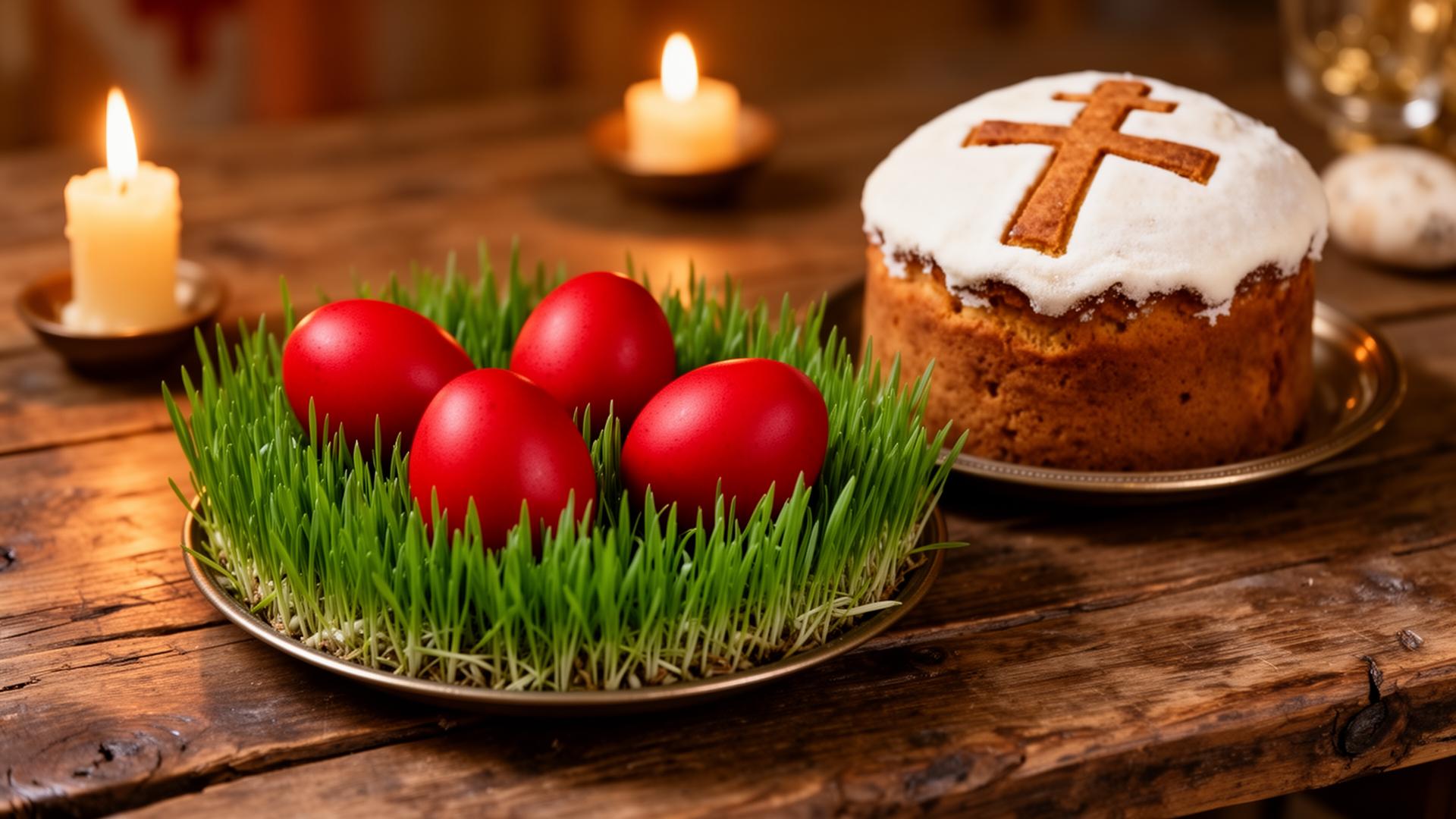
If you visit any market in Tbilisi or Kutaisi during the weeks before Easter, you will notice bundles of dried brown sticks tied with ribbon. This is endro, or madder root. Boiled in water, it produces a deep scarlet dye used to colour hard-boiled eggs on the Friday before Easter Sunday (Tsiteli Paraskevi translates literally as "Red Friday").
The red represents the blood of Christ and a story about Mary Magdalene: when she told the Roman Emperor that Jesus had risen, he said that was about as likely as the eggs in her basket turning red on the spot. They did. Georgian families gather in kitchens on Friday afternoon to dip their eggs before sunset. Some add onion skins for a richer tone. Unlike in Romania or Ukraine, the eggs are dyed a uniform colour with no wax patterns or decoration.
Alongside the eggs, sprouts of wheatgrass (jejili) appear on windowsills and market tables. Seeds are planted on damp cotton a week before Easter and grow into vivid green tufts that symbolise renewal. The finished display, red eggs resting on a bed of wheatgrass, is the visual centrepiece of every Georgian Easter table.
Midnight Mass and the Holy Fire
The spiritual climax of Easter happens late on Saturday night. Litonioba, the Easter vigil, begins at midnight in every church across the country. But the ritual has a physical starting point thousands of kilometres away: the Holy Fire ceremony at the Church of the Holy Sepulchre in Jerusalem.
Each year since 1995, a lit torch has been flown from Tel Aviv to Tbilisi Airport on a Georgian Airways flight. From the airport, the flame is distributed to major churches. At Sameba Cathedral, the capital's largest church, the arrival of the fire is the emotional peak of the evening. In smaller churches, the flame arrives by relay from Tbilisi.
At midnight, bells start ringing and do not stop for ten to fifteen minutes. Parishioners light votive candles (buy them from the church shop during the day, and do not bring your own lighter, because lighting your candle from a stranger's flame is the whole point). Then the congregation walks three times around the exterior of the church while chanting and singing. This is called the Procession of the Cross, and it is the most emotionally powerful moment of the Georgian year.
The full service runs until 2 or 3am. Nobody will judge you for leaving after the procession. Standing in the churchyard rather than inside the church gives you more room to breathe and makes it easier to slip away.
Where to Go for Litonioba
- Sameba Cathedral, Tbilisi: The biggest and most ceremonial service. Plenty of room to stand inside. National costumes, the Holy Fire arrival, the full production.
- Anchiskhati Basilica, Tbilisi: The city's oldest surviving church. Tiny interior, so you will be outside, but the liturgical chanting from the choir is extraordinary.
- Svetitskhoveli Cathedral, Mtskheta: Just 20 minutes from Tbilisi, Georgia's most sacred cathedral offers a particularly atmospheric service. Drive there early to park. We offer free delivery to any address, so you can pick up a car in Tbilisi and drive out.
- St. George English Language Orthodox Church, Dighomi: The only Litonioba service in English. Located in a northern Tbilisi suburb.
Dress Code and Etiquette at Church
Georgian churches enforce a strict dress code year-round, and Easter is no exception. Women should wear long sleeves, a long skirt or dress (not trousers), and a headscarf. Men should wear long trousers and long sleeves. Dark colours are preferred. Dress warmly because you will be standing outside for at least an hour in early April temperatures.
If you are not a member of the Orthodox Church, do not partake in Communion. Everything else, including lighting candles, joining the procession, and greeting people, is open to everyone regardless of faith.
Easter Food: Three Dishes You Need to Try
The 40-day Lenten fast that precedes Easter means no meat, dairy, fish, or eggs. When the fast breaks on Sunday morning, the table groans under the weight of celebratory dishes. Three are specifically tied to Easter:
Paska
A tall, dome-shaped butter cake dense with cinnamon, nutmeg, cloves, and raisins. Every family makes their own version. Store-bought paska is available at bakeries and supermarkets across the country. In Tbilisi, the Bazari Orbeliani market hosts a special Easter market where home bakers sell their cakes. The texture is deliberately dry because paska is designed to be broken and shared, not sliced neatly.
Chakapuli
A fragrant spring stew of lamb (sometimes veal) braised with tarragon, sour green plums, and dry white wine. The dish originated in the Kakheti wine region and is available year-round, but its association with Easter and the first appearance of tarragon in spring make this the right time to eat it. Some restaurants serve a mushroom version for vegetarians.
Gurian Khachapuri
A crescent-shaped cheese bread stuffed with sulguni and sliced hard-boiled egg. This regional specialty from Guria is Georgia's official Easter khachapuri. It looks like a calzone and tastes richer than the standard Imeretian version.
The Cemetery Feast on Monday
Bright Monday is when Easter moves outdoors. Families drive from the city to their ancestral village cemeteries to commune with the dead. The streets of Tbilisi empty. Traffic on the highways backs up.
At the graveside, the ritual goes like this: candles are lit, a red egg is rolled three times across the headstone (echoing the rolling away of the stone from Christ's tomb), then a miniature supra feast is laid out on the grave. Wine is poured onto the earth for the deceased. This is called "knocking over the goblet." The atmosphere is warm, not mournful. Families eat, drink, and catch up with neighbours between the headstones.
This tradition solidified during the Soviet era when churches were closed and Easter services banned. Cemeteries became the only place people could pray openly. The custom persisted long after the churches reopened.
As a visitor, you are welcome to observe. Walk through any cemetery on Monday morning and you will see families. Greet them warmly and they may invite you to sit down. Ask permission before taking photographs.
Lelo Burti: Rugby Without Rules
In the village of Shukhuti in Guria, Easter Sunday brings Lelo Burti, a 300-year-old full-contact ball game that makes rugby look gentle. Two rival village teams compete to carry a 16-kilogram leather ball (filled with sand and soaked in wine) 500 metres to the other team's stream. There are no referees, no fixed teams, and only the vaguest sense of rules.
Hundreds of players pile into each scrimmage. The crowd lines the main road. There is live music, food stalls, and a local produce market alongside the match. If you want to witness Lelo Burti, you need a car. Batumi is the closest major city, and we deliver free there.
Bonfires on Thursday Night
Chiakokonoba, observed on the Thursday before Easter, is the tradition most visitors never hear about. Families build bonfires and jump over the flames. The fire is believed to purify the jumper and ward off evil spirits. The custom shares roots with the Persian Nowruz tradition of Chaharshanbe Suri.
Chiakokonoba was once practised across the country, from Svaneti to Guria, but has faded significantly. You are most likely to see it in rural villages. In cities, it has all but disappeared.
Practical Information for Visitors
Will things be closed?
Banks, national museums, and government offices close Friday through Monday. Most restaurants, supermarkets (with shorter hours), pharmacies, and larger shops stay open. Smaller family-run businesses may close on Friday, Sunday, or Monday.
Transport during Easter
City buses and the Tbilisi metro run throughout, with extended hours on Saturday night (metro until 4am for churchgoers). On Sunday and Monday, buses to Tbilisi's cemeteries are free. Intercity marshrutkas may run reduced schedules. Taxis are harder to find because many drivers take the days off.
The worst traffic: leaving Tbilisi toward Batumi on Thursday, returning to Tbilisi on Tuesday. Plan accordingly.
Driving at Easter
A rental car is the most reliable way to move around during the holiday weekend. Public transport schedules become unpredictable, and the places worth visiting (Mtskheta for Litonioba, Shukhuti for Lelo Burti, village cemeteries on Monday) are all outside Tbilisi. We deliver free to any address in Tbilisi, Tbilisi Airport, or Batumi. No deposit, unlimited mileage.
The Easter greeting
On Sunday and Monday, replace the standard "gamarjoba" with Kriste agdga (kr-is-tey ag-d-ga), meaning "Christ has risen." The reply is Cheshmaritad (chesh-mar-ee-tad): "Indeed he has."
Is Easter a Good Time to Visit Georgia?
Yes. April in Georgia means mild temperatures, cherry blossoms in the city, and the first green on the mountain slopes. The holiday closures are limited and manageable. What you gain, the chance to witness traditions that date back centuries, far outweighs what you lose. Plan your transport in advance, pack respectful clothing for church, and lean into the experience.
For more on travelling in spring, read our Tbilisi spring guide, our complete Georgia spring guide, or our wildflower guide.
Frequently Asked Questions
When is Orthodox Easter in Georgia in 2026?
Easter Sunday falls on April 12, 2026. The four national holidays run from Red Friday (April 10) through Bright Monday (April 13).
Can tourists attend the midnight Easter church service?
Yes. Litonioba is open to everyone regardless of faith. Dress modestly (long sleeves, long skirt or trousers, headscarf for women), buy votive candles beforehand, and do not take Communion if you are not Orthodox.
What special foods are eaten at Easter in Georgia?
The three signature Easter dishes are paska (a dense fruit cake), chakapuli (lamb stew with tarragon and sour plums), and Gurian khachapuri (crescent-shaped cheese bread with egg). All are widely available at restaurants and bakeries during Holy Week.
Do restaurants and shops close for Easter in Georgia?
Most restaurants, supermarkets, and pharmacies remain open, though some may have shorter hours. Banks, museums, and government offices close Friday through Monday. Smaller family-run establishments may close for one or more days.
What is Lelo Burti?
A traditional full-contact ball game played every Easter Sunday in the Gurian village of Shukhuti. Two teams compete to carry a heavy leather ball across a stream. It has been played for over 300 years and draws large crowds.