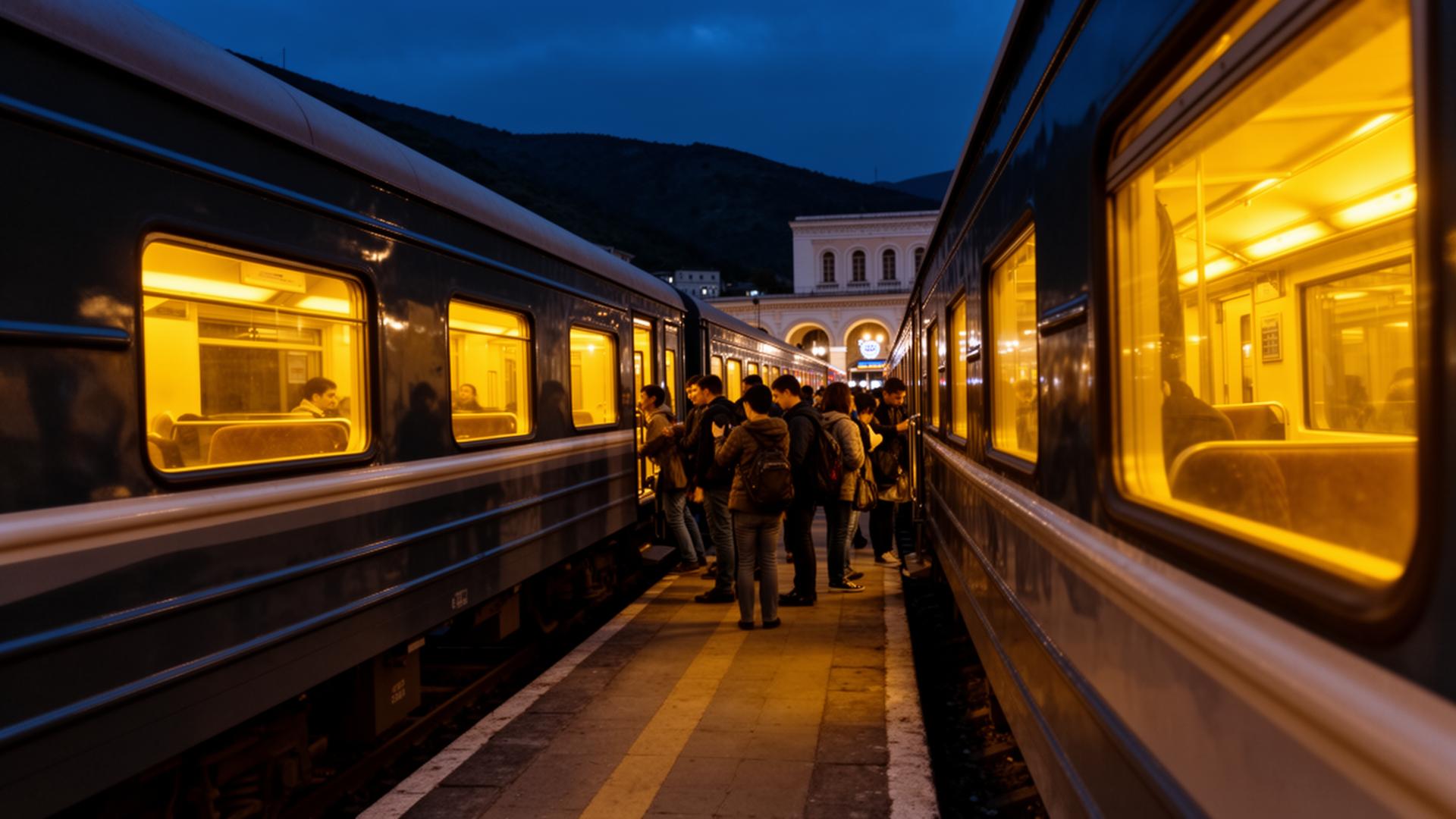
The overnight train between Tbilisi and Yerevan is one of the last great slow-travel connections in the Caucasus. It covers roughly 380 kilometres in about ten hours, crossing the Georgian-Armenian border at Sadakhlo-Ayrum while you sleep. You board in the evening, wake up in a different country, and — if you are heading toward Yerevan — catch glimpses of Mount Ararat through the carriage window as the train rolls into the capital.
It is not the fastest option. A rental car covers the same distance in five to six hours, and marshrutka minivans do it in about seven. But the train has its own appeal: affordable fares, a comfortable bed, no worries about mountain roads at night, and a crossing experience that feels closer to real travel than sitting in a minibus seat.
This guide covers everything practical — schedules, ticket classes, prices, how to buy, what the border procedure looks like, and how the train compares to driving yourself.
Current Schedules (2025–2026 Season)
The train runs on two seasonal timetables. Summer service typically begins in mid-June and ends in late September. Winter service covers October through early June.
Winter Schedule (October–June)
During the low season, the overnight sleeper runs every other night. From Tbilisi, train #371 departs on odd-numbered calendar days (the 1st, 3rd, 5th, etc.) at approximately 8:20pm and arrives in Yerevan at 6:55am. From Yerevan, train #372 leaves on even-numbered days at 9:30pm and reaches Tbilisi at 7:35am.
Total journey time is about 10 hours each way. The border crossing happens roughly two hours after departure from Tbilisi (around 10:30pm) or six hours after departure from Yerevan (around 4:40am).
Summer Schedule (June–September)
In summer the service extends to Batumi, making it a Batumi–Tbilisi–Yerevan route. The train still runs every other night, not daily. From Tbilisi, train #201 stops at Tbilisi Central at about 9:47pm (having originated in Batumi at 2:45pm) and arrives in Yerevan at 9:00am. From Yerevan, train #202 departs at 2:00pm and passes through Tbilisi just after midnight before continuing to Batumi.
The summer Yerevan-bound departure is the better option for scenery — the train passes through the Debed Canyon and northern Armenia's forested gorges, though much of this happens at night. Heading toward Tbilisi on the afternoon departure, you get daylight views of the Armenian highlands and the approach to the Georgian border.
Stops Along the Route
The train makes brief stops (2–5 minutes each) at several stations between the two capitals, including Vanadzor and Gyumri in northern Armenia. At Gyumri the stop is longer — about 20 minutes. In summer, additional stops between Tbilisi and Batumi include Zestafoni, Samtredia, and Kobuleti on the Black Sea coast.
Ticket Classes and Prices
Three main berth types are available on the Tbilisi–Yerevan train:
- First class (Spalny Vagon/CB): A private two-bed compartment with air conditioning, linens, individual lights, power sockets, a small safe, and sometimes a TV. Fares start from about 217 GEL (roughly $80) from Tbilisi or 30,500 AMD from Yerevan.
- Second class (Kupeynyy): A four-bed closed compartment with similar amenities minus the TV. Fares start from about 137 GEL or 19,250 AMD.
- Third class (Platskartny): An open-plan carriage with bunks and no cabin doors — the most affordable and social option. Fares start from about 103 GEL or 14,465 AMD.
Bottom bunks cost slightly more than uppers (around 5 GEL difference). An "increased comfort" upgrade for second class adds slippers, toiletries, and tea for about 3,000 AMD extra. Children under five ride free; ages 5–10 receive a roughly 25% discount. Prices fluctuate slightly by day and season — July and August tend to be about 5% higher than June.
How to Buy Tickets
At the Station (Most Reliable)
The most straightforward method is buying in person at either Tbilisi Central Railway Station (level three, ticket desks open 8am–8pm) or Yerevan's Sasuntsi Davit Station (desks open 9am–6pm). You need your physical passport — photocopies and phone images are no longer accepted. Payment is in local currency; card machines exist but frequently malfunction, so bring cash.
Tickets go on sale 40 days before departure. In summer (especially July and August weekends), popular classes sell out quickly. In winter, same-day purchase is often possible.
Online via South Caucasus Railways
The Armenian railway website (ticket.ukzhd.am) sells tickets online in English, Armenian, and Russian. You create an account with your passport details, search for your date, select a class, and pay by Visa or Mastercard. There is a service fee of about 2,000 AMD per ticket.
Fair warning: the website is unreliable. Payment fails frequently, error messages appear without explanation, and seat availability sometimes shows incorrectly. If it works, you will receive an email confirmation. Print everything — the ticket confirmation, the voucher with your carriage and berth number, and if possible a Russian-language version. Station staff occasionally have trouble verifying e-tickets.
Through a Tour Agent
A few Tbilisi-based agencies can pre-purchase tickets on your behalf. This is convenient but significantly more expensive — first class tickets through agents can run over $180 per person, roughly double the station price.
What the Train Is Like
The old Soviet carriages were replaced with newer Russian-manufactured cars. They are not luxury, but they are clean and functional. Beds have double-layer mattresses and decent pillows. About 30 minutes into the journey, the steward distributes sealed linen packs (two sheets, a pillowcase, and a towel).
Each carriage has two bathrooms with toilet, sink, and shower. There are individual power sockets in every berth, overhead luggage storage above the doorway, and larger bags go under the bottom bunks. Central air conditioning runs while the train is moving but can cut out during long border stops.
There is no dining car. Hot water dispensers and a microwave are available, and first class passengers receive a bottle of water, but you should bring your own food and drinks. A few practical items worth packing: snacks and water for the night, a sleeping mask and earplugs, toilet paper or wet wipes (bathroom supplies deplete as the night goes on), and a light layer in case the air conditioning drops during the border wait.
Border Crossing: Georgia to Armenia
The train crosses at Sadakhlo (Georgian side) and Ayrum (Armenian side). The entire process takes 1.5 to 2 hours and usually happens while the train is stationary.
Georgian exit: Border agents board the train, collect passports from each compartment, process them using portable computers, and return them with exit stamps. You normally stay in your berth. This takes about an hour.
Armenian entry: After a short transit, Armenian agents repeat the process. Citizens of 45+ countries (including EU, US, UK, and Australian passport holders) enter visa-free for up to 180 days, so the process is just a passport stamp. Armenian immigration is typically faster — 15 to 30 minutes.
If you need a visa, you can obtain one on arrival at the border for 3,000 AMD (about $7) for a 21-day tourist visa. Pay in Armenian dram — agents are reluctant to accept foreign currency. Have the exact amount ready.
Keep your train ticket accessible during the crossing — agents may cross-reference it against passenger lists. The cabins stay lit with doors open until processing is complete, which can feel long if you are trying to sleep.
If You Have Previously Visited Azerbaijan
There is no law preventing entry to Armenia after visiting Azerbaijan, but border agents may ask additional questions about your movements — where you went, how long you stayed, your accommodation details. Having this information readily available (hotel confirmations, travel dates) speeds things up considerably. Without it, the questioning can extend well past an hour.
Train vs. Driving: Which Makes More Sense?
The train is a wonderful experience, but it is not always the most practical choice — especially if you plan to explore Armenia beyond Yerevan.
| Train | Rental Car | |
|---|---|---|
| Travel time | 10–11 hours overnight | 5–6 hours (daytime) |
| Cost (2 people) | ~$100–160 total | From €40/day + fuel |
| Flexibility | Fixed schedule, every other night | Leave whenever you want |
| Stops en route | Only at stations | Haghpat, Sanahin, Dilijan, Lake Sevan |
| Armenia mobility | Need taxis/tours in Yerevan | Full independence for the entire trip |
| Border process | Done on the train while you rest | Drive-through at Sadakhlo-Bagratashen (30 min) |
If your goal is simply to get from one capital to the other and you enjoy train travel, the sleeper is hard to beat. But if you want to stop at the medieval monasteries of Haghpat and Sanahin in the Debed Canyon, spend a night in Dilijan's forested mountains, or loop around Lake Sevan before reaching Yerevan, a car gives you that freedom.
We offer cross-border car rental from Tbilisi to Yerevan with no deposit, unlimited mileage, and all border documentation included. Pick up in Tbilisi or at Tbilisi Airport and drop off in Yerevan or at Zvartnots Airport. A Hyundai Elantra handles the highway comfortably; for mountain detours and unpaved monastery access roads, a 4x4 from our Yerevan fleet is the better choice.
Practical Tips
- Buy tickets early in summer. July and August weekends sell out. Aim for 2–3 weeks in advance at minimum.
- Bring AMD for the border. If you need a visa on arrival, agents insist on Armenian dram. Not all Tbilisi exchange offices carry it — try the small offices behind Avlabari Metro Station.
- Arrive 45 minutes early. The train is usually on the platform 30 minutes before departure, and claiming your berth early means you can settle in before the rush.
- Pack food. No dining car means you need snacks, water, and anything else you want for a 10-hour journey. Hot water is available for tea and coffee.
- Bring a SIM card. If you have a Georgian SIM, activate roaming before departure so your phone works after crossing into Armenia.
- Lock your cabin. Second and first class compartments lock from inside. Use the lock overnight for security.
Frequently Asked Questions
How long is the train from Tbilisi to Yerevan?
About 10 to 11 hours depending on the season. The winter train takes roughly 10 hours 35 minutes; the summer service takes about 11 hours 15 minutes due to additional stops.
Does the train run every day?
No. It runs every other night year-round. In summer it may run more frequently some months, but daily service is not guaranteed. Check the South Caucasus Railways website for exact dates.
Can I buy a return ticket?
Yes. You can purchase round-trip tickets at Tbilisi Central. This is actually recommended since it saves you from queuing at Yerevan station, where ticket lines can be long due to bulk-buying agents.
Is the train safe?
Yes. The train is widely used by local families and travellers. First and second class compartments lock from inside. Hallways are well-lit throughout the night. Standard precautions apply — keep valuables close and lock your door.
Can I take the train from Batumi to Yerevan?
In summer only. The service extends to Batumi, departing around 2:45pm and stopping in Tbilisi en route. In winter, the train only operates between Tbilisi and Yerevan.
What if I want to stop in Dilijan or Lake Sevan on the way?
The train passes through northern Armenia but only stops briefly at a few stations. For a flexible itinerary with stops, renting a car is the better option. You can drive the same route at your own pace and detour to monasteries, mountain towns, and Lake Sevan along the way.